
To start a voice journal, pick one moment in your day you already have (the walk to the car, the first coffee, the drive home), and talk for two to five minutes about whatever is on your mind. Use any app that records and transcribes. Don't listen back during the first week; just show up each day, then read everything once on day seven.
That's the whole method. The rest of this guide is how to make it stick and what to say when nothing comes.
Why voice instead of writing?
Talking is faster than typing for most people, and you can do it while walking, cooking or driving. It also gets past the blank-page problem: it's easier to start a sentence out loud than to start one on paper.
Writing still has advantages. It's quieter, it's easier to edit, and the slower pace can help you think more carefully. I've compared the two honestly in voice journaling vs writing, and summarized the research (which is mostly about writing, not speaking) in does voice journaling work?.
If you've tried a written journal and kept missing days, voice is worth a week.
How do I set up a voice journal on iPhone?
You have three realistic options. Each one works.
| Option | What you get | What it doesn't do |
|---|---|---|
| Apple Voice Memos | Free, already installed. On iOS 18 or later, supported iPhones show a transcript of each recording | No prompts, no sorting. Entries are files in a list |
| Apple Journal | Free diary app. Voice entries are transcribed and dated, with suggestions from your photos and places | Doesn't pull to-dos out of what you said |
| A voice journal app like Nuro | Transcript plus audio, a short summary, suggested to-dos you confirm, search by meaning | Costs money (Nuro is a subscription) and is iPhone only |
If you're not sure, start with Voice Memos for a week. If you find yourself saying a lot of "I need to..." and then forgetting it, that's when an app that sorts entries starts to earn its place. I compared the dedicated apps in the best brain dump apps.
When should I record?
Attach it to something you already do every day. A new habit sticks better when it rides on an old one. Good anchors:
- The walk or drive home. You're switching from work to home anyway. This doubles as an end-of-work shutdown.
- First coffee. Good for planning the day.
- Right before bed. Good for parking tomorrow's list, though keep it short. There's one small sleep study on that.
Pick one. Don't try to record morning and evening in the first week.
How long should a voice journal entry be?
Two to five minutes is plenty. Long enough to get past "um, so, today was fine", short enough that you won't dread it. Some days you'll go for fifteen. Some days it'll be forty seconds. Both count.
What should I say? Five prompts that work out loud
Written prompts often fail when spoken ("Describe a moment of gratitude" sounds stiff in your own voice). These work better out loud:
- "What's taking up the most room in my head right now?" Then just keep talking.
- "What happened today that I'll have forgotten by next week?" Small details are what make old entries worth reading.
- "What am I putting off, and why?" Usually there's a reason, and saying it out loud makes it smaller.
- "What's coming up this week?" This is where to-dos and dates show up naturally.
- "What do I want to remember about how I felt today?" One or two words is fine.
If none of these lands, describe where you are and what you can see. Talking about anything warms you up to talking about something.
Your first week, day by day
- Day 1: Record at your anchor moment. Use prompt 1. Stop when you run out.
- Day 2: Same time. Prompt 2.
- Day 3: Same time. Prompt 3. If you missed day 2, don't make it up. Just carry on.
- Day 4: Prompt 4. Notice whether you mention things you need to do.
- Day 5: Prompt 5.
- Day 6: No prompt. Just talk.
- Day 7: Read or listen back to all six. Ask: what came up more than once? What did I say I'd do, and did I?
Day seven is where a voice journal starts to pay off. You hear what kept coming up, which is hard to notice from inside a single day.
How Nuro handles the first week
I make Nuro, so weigh this accordingly. Here's what it does with each of those entries, and nothing more:
- Starting is one tap. Add the Nuro widget to your Home Screen or Lock Screen, or add it to Control Center, and it opens already recording. Recording keeps going if you lock the phone, with Pause and Stop on the Lock Screen, so you can talk with the phone in your pocket on the walk home. Recordings can run up to 30 minutes.
- Typing when you can't talk. Hold the record button to type instead. Typed entries are searched and handled the same way.
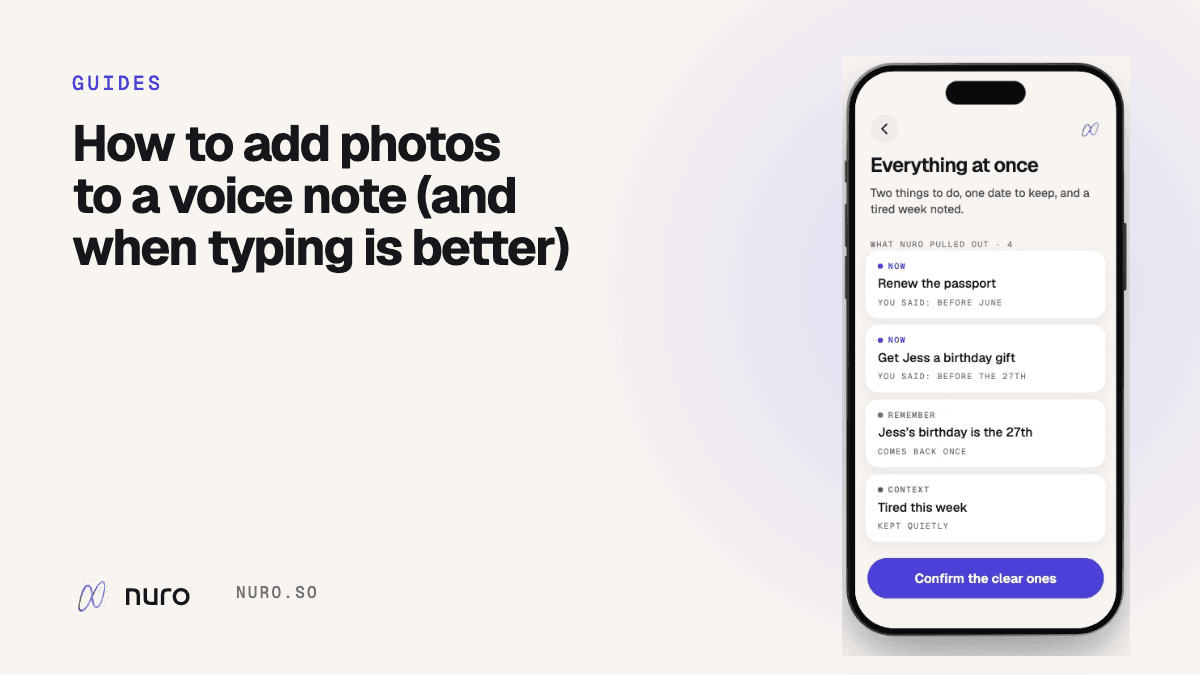
- To-dos only when you confirm them. Nuro suggests to-dos from what you said, and nothing goes on your list until you confirm it. If you named a day ("call the garage Thursday"), Nuro reminds you that day.
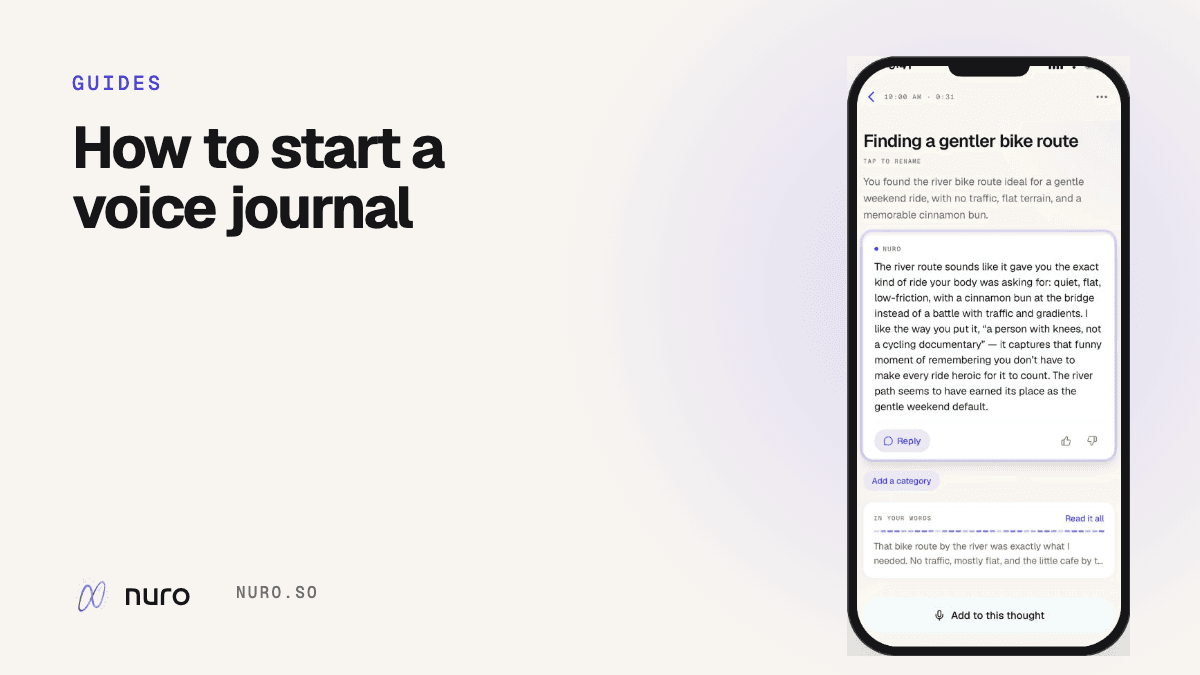
- A short reply. A few seconds after saving, Nuro's Take appears under the entry: a few sentences reflecting something you said. You can reply, rate it or ignore it. It's AI and can misread you, and it isn't advice or therapy.
- Day seven is easier. Search by meaning finds entries even when you don't remember the words, and Ask Nuro answers a question from your own entries and shows which ones it used.
Try it out loud: your first entry, right now
Don't wait for tomorrow. Open whatever app you'll use and say these three sentences:
- "Today is [day], and I'm starting a voice journal because..."
- "The thing on my mind most right now is..."
- "By the end of this week I'd like to have..."
That's an entry. You've started.
FAQ
Is a voice journal as good as a written one?
They're different. Writing is slower and quieter, which some people find more reflective. Speaking is faster and easier to start. Most of the research is about writing, so nobody can say one is better for everyone. Use the one you'll actually do.
Do I have to listen to my old entries?
No, but read or listen back once a week if you can. That's where you notice patterns, like the same worry coming up four days running. A transcript makes this quicker than listening.
What if I feel awkward talking to myself?
Almost everyone does at first, and it usually fades within a few days. It's also more normal than it feels: I went through the research in is talking to yourself normal?
Is a voice journal private?
It depends on the app. Voice Memos and Apple Journal keep entries with your Apple account. Nuro stores entries in your account on its servers, and what you say isn't used to train AI models. Read any app's privacy page before you pour your heart into it; here's Nuro's.
Related reading: Why do I get my best ideas in the shower? · How to practice a wedding speech out loud · How to brain dump