
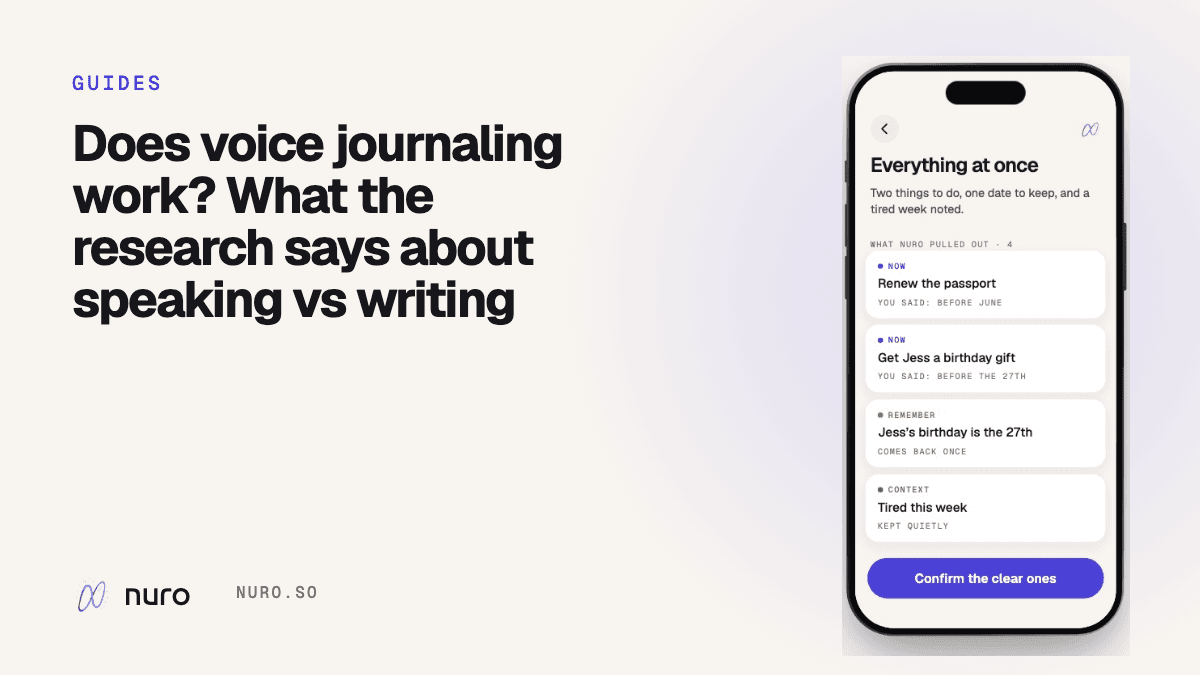
Voice journaling probably works in roughly the way written journaling does, but the honest answer is that almost all the research is about writing. Decades of expressive-writing studies found small average benefits from writing about your thoughts and feelings, and the few studies that compared talking with writing found talking did about as well, and on some measures better.
So: promising, modest, and not well tested for voice journaling apps specifically. Here's the detail.
Where the research comes from: expressive writing
The starting point is psychologist James Pennebaker. In an early study, Pennebaker and Beall (1986) asked 46 university students to write for 15 minutes on four days in a row. Some wrote about a traumatic or upsetting experience; others wrote about trivial topics. The students who wrote about both the facts and their feelings were more upset straight after writing, but made fewer visits to the campus health center in the months that followed.
That setup, now usually called expressive writing, was repeated and varied in well over a hundred randomized studies. By 1997, Pennebaker could write in Psychological Science (Pennebaker, 1997) that a decade of studies had linked writing about emotional experiences with improvements in physical and mental health. He also argued that what changed in people's thinking and language while they wrote (for example, starting to make sense of what happened) predicted the benefits better than simply getting things off their chest.
How big is the effect?
Small. The best single summary is a 2006 meta-analysis by Joanne Frattaroli in Psychological Bulletin, which pooled 146 randomized studies of this kind of disclosure. The average effect was positive and statistically significant, but small: an effect size of r = .075. The paper also found that the size of the effect depended on factors such as who took part and how the study was run.
In plain terms, writing about your feelings helps a little, on average, across lots of studies, and it doesn't help everyone. Anyone selling journaling as life-changing is going well beyond the evidence. So is anyone saying it does nothing.
What happens when people talk instead of write?
This is the part most "benefits of voice journaling" articles skip, because there isn't much of it.
The clearest study is Esterling and colleagues (1994), in the Journal of Consulting and Clinical Psychology. They took 57 healthy undergraduates who carried the Epstein-Barr virus (very common, and usually dormant) and randomly assigned them to one of three groups for three weekly 20-minute sessions:
| Group | What they did | What changed |
|---|---|---|
| Spoken, stressful | Talked about stressful events | Lowest antibody levels afterwards (read as better immune control of the dormant virus), and the biggest improvements in rated cognitive change, self-esteem and coping |
| Written, stressful | Wrote about stressful events | Antibody levels in between; used more emotion words than the speakers |
| Written, trivial | Wrote about everyday, neutral topics | Highest antibody levels (the comparison group) |
So in this one study, speaking about stress did at least as well as writing about it, and on the immune measure and the content ratings it did better.
Pennebaker's 1997 review summed up the comparison research the same way: most studies comparing writing with talking, either into a tape recorder or to a therapist, found comparable effects on biology, mood and thinking.
What those studies don't tell you
A few honest limits, because they matter:
- The spoken evidence is thin. Esterling 1994 had 57 people, all students, over three weeks. It's a good study, not a body of evidence.
- "Immune" here means one blood marker. Lower Epstein-Barr antibody levels were interpreted as better immune control. That's not the same as "you'll get sick less".
- The studies tested a specific exercise, usually 15 to 20 minutes about something emotionally important, a few sessions in a row. Most voice journaling is different: shorter, more frequent, and often about ordinary days, plans and to-dos. Nobody has tested that properly.
- No one has studied voice journaling apps. I couldn't find a controlled trial of any app, including mine.
- It can feel worse first. In the original studies, people often felt more upset right after writing about something painful. That's expected, but it's worth knowing.
Spoken vs written journaling: a practical comparison
Setting the studies aside, here's how the two tend to differ in practice. This is my view, not a research finding. There's a longer version in voice journaling vs writing.
| Speaking | Writing | |
|---|---|---|
| Getting started | Low effort; no blank page | Can stall on the first sentence |
| Speed | Usually quicker than typing on a phone | Slower, which can help you think |
| Editing as you go | Harder to polish mid-sentence | Easy to edit, sometimes too early |
| Privacy | Needs somewhere you won't be overheard | Silent, works anywhere |
| Reading it back | Needs a transcript | Already on the page |
| Emotion words | Fewer in Esterling 1994 | More in Esterling 1994 |
If you want more on why speaking helps you think in the moment, I wrote about it in the science of thinking out loud.
Try it out loud: a five-minute spoken entry
This is loosely based on the expressive-writing instructions, shortened and spoken. Pick something that's been on your mind, not necessarily something big.
- Say what happened, briefly. One or two sentences of facts. "The review meeting got moved again and I found out from someone else."
- Say how you feel about it. Use real feeling words. "Annoyed. And a bit embarrassed that I didn't know." If you want more on why naming the feeling may help, see name it to tame it.
- Say why it matters to you. This is the part the research suggests counts most: making some sense of it. "I think it bothers me because it feels like I'm out of the loop on my own project."
- Say what, if anything, you'll do. "Ask Dev on Monday to add me to the invite list." It's fine if the answer is nothing.
- Stop at five minutes. If it's something painful and you feel worse, that's common at first. If it stays heavy, talking to someone you trust, or a professional, is a better next step than more journaling.
I make Nuro, so weigh this accordingly. When you speak an entry like this, Nuro transcribes it and keeps your words, pulls out possible to-dos (like "Ask Dev to add me to the invite list") for you to confirm, and Nuro's Take gives you a short AI reflection on what you said. You can do the exercise with any voice recorder, though. The talking is the part the research is about.
FAQ
Is voice journaling as good as writing?
In the few studies that compared them, talking about emotional experiences worked about as well as writing, and in Esterling 1994 slightly better on some measures. Those studies are small, so "about as good, as far as we know" is the fair answer.
How long should a voice journal entry be?
The research setups mostly used 15 to 20 minutes over a few days, but no one has tested shorter daily entries well. A few minutes you'll actually do is more useful than 20 minutes you won't.
Do I need to listen back to my voice journal?
None of the studies required it. The benefit they measured came from the speaking or writing itself. A transcript is still handy if you want to find what you said later.
Is voice journaling a form of therapy?
No. It's a way of putting your thoughts into words. If you're struggling, a trained professional can offer things a journal can't.
Related reading: Voice journaling vs writing · The science of thinking out loud · Name it to tame it · Is talking to yourself normal?