
Pick ChatGPT voice mode if you want someone to think with: a voice that asks follow-up questions, helps you untangle a decision and can act on it right away, on any device, with a free tier. Pick Nuro if you want a dated record of what you said that you can search and replay later, a to-do list that builds from your own words, and a place for things to remember and feelings that isn't a task list.
I make Nuro, so weigh this accordingly. And I'll say it plainly: ChatGPT is a great thinking partner. A lot of people use both.
One example: the physio appointment
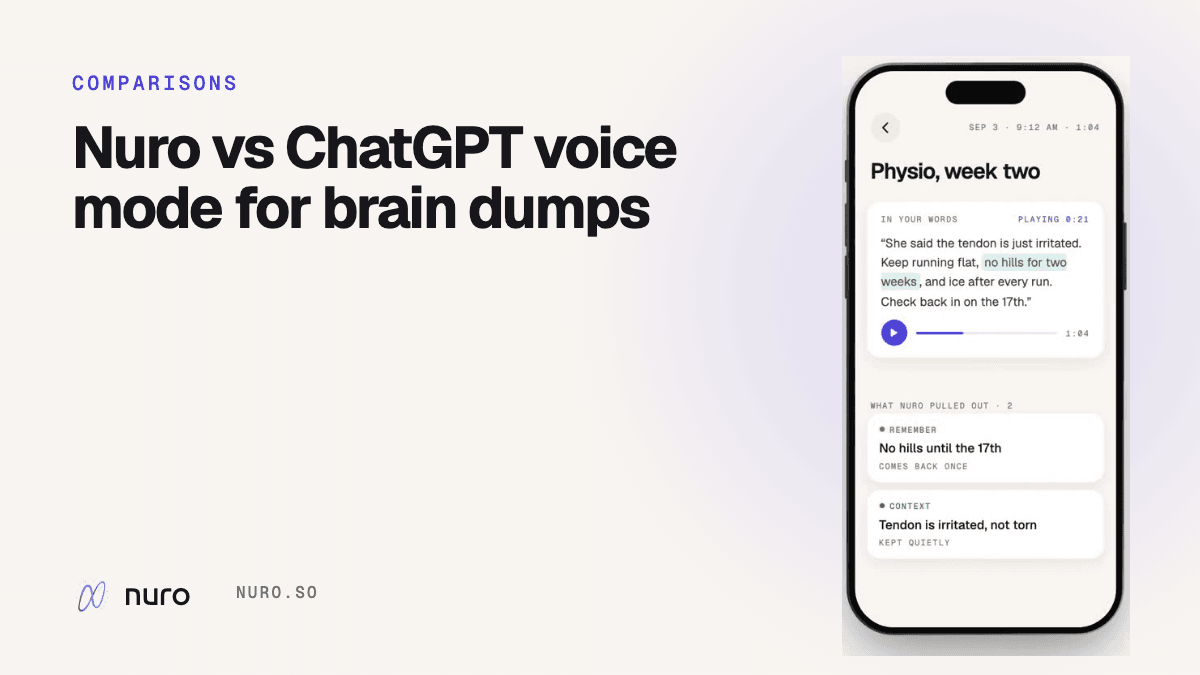
On 3 September you leave a physio appointment and talk it through on the walk home: "She said the tendon is just irritated. Keep running flat, no hills for two weeks, and ice after every run. Check back in on the 17th."
In ChatGPT, you might say that out loud and get a thoughtful reply: what to ask next time, how to adjust your running week. That conversation is genuinely useful in the moment.
In Nuro, the entry is saved with its date and your recording. It opens with a one-line summary written to you, and Nuro suggests a thing to remember, "No hills until the 17th", and keeps "Tendon is irritated, not torn" as context. Because you said the date, that remember item comes back once, a few days before the 17th, when you next open the app.
Three weeks later, someone asks what the physio actually said. In Nuro you type "what did the physio say about my knee", the right entry comes up (search finds things by your words and by meaning), and you press play on your own voice from that afternoon.
In ChatGPT, you could search your chats, and its memory might have kept a note about your knee. What you'd find is a conversation, not your own words on a date, and not the recording.
Side by side
| Nuro | ChatGPT voice mode | |
|---|---|---|
| What it is | A voice journal and brain dump app | A conversational AI assistant |
| Talks back | No. A one-line summary and suggestions | Yes, natural back-and-forth |
| Dated record of what you said | Yes, every entry | Chats, organized as conversations |
| Your original audio | Kept next to the transcript | Voice audio kept 30 days |
| Search | Your words, or close in meaning | Search across chats |
| A lasting to-do list from what you said | Yes, you confirm each item | No |
| Reminders | Once, for a "remember" item with a date you said; never for to-dos | Scheduled tasks, requested one at a time, capped |
| Things to remember and context | Kept separate from tasks | Saved memories about you |
| Apple Watch | Yes | No official app |
| Platforms | iPhone, Apple Watch, web reader | iPhone, iPad, Mac, Windows, Android, web |
| Price | $6.99/mo or $49.99/yr, no free plan | Free; Plus $20/mo |
| AI training | Not used to train AI, by Nuro or OpenAI | May be used unless you turn it off |
Prices checked October 2026.
Where ChatGPT is better
It talks back. This is the big one. If you're stuck on a decision, a voice that asks "what would you regret more?" can move you further than any list. Nuro doesn't chat with you at all.
It can act straight away. Draft the email, plan the week, explain the thing you don't understand. Nuro sorts what you said; it doesn't do work for you.
It remembers you across chats. ChatGPT's memory uses saved memories and your chat history to keep context about you over time.
Reminders on request. Ask ChatGPT to remind you of something and its scheduled tasks will. Nuro deliberately never reminds you about to-dos.
It's everywhere, and there's a free tier. iPhone, iPad, Mac, Windows, Android and web. On paid plans, the Mac app also has a Record mode for long sessions of up to four hours. Nuro is iPhone and Apple Watch only, with a web reader, and it has no free plan.
Where Nuro is better
A dated record you can go back to. Every entry is kept with its date, a one-line summary, the full transcript and your audio. Months later you can find it by the words you used or by what you meant, and hear exactly what you said. That's hard to recreate from a pile of chats.
A list that builds itself from what you said, with your say-so. Nuro suggests to-dos from your entry and nothing lands on your list until you confirm it. Confirmed items go on an Open list grouped by Today, This week, Later and No date yet, and you check them off. In ChatGPT, there's no persistent list built from your words; you'd have to ask for one each time.
Remember and context, kept apart from tasks. Some of what you say isn't a task: a date you'll need, a figure, how you felt. Nuro keeps those as things to remember and context, and context never turns into a task.
No invented dates. If you didn't say when, Nuro files it under No date yet instead of guessing.
Your wrist. Nuro has an Apple Watch app for capturing on the move, and it records offline. ChatGPT doesn't have an official Watch app.
Dates come back without you asking. In ChatGPT you set each reminder up yourself, and scheduled tasks are capped at 3 active on Free and Go, 5 on Plus and 10 on Business. In Nuro, a "remember" item with a date you said simply comes back once, a few days before, with nothing to set up. To-dos never nag; an undated one that's sat for 21 days gets a single "Still true?" question, once.
Pricing
ChatGPT (pricing): voice mode is available on the free plan. Plus is $20 a month, and there are cheaper and more expensive tiers (Go, and Pro). I couldn't confirm the exact price of every tier on OpenAI's own page, so check before you buy.
Nuro: $6.99 a month or $49.99 a year, as an iOS subscription. No free plan.
Prices checked October 2026.
Privacy
By default, ChatGPT may use your conversations to improve its models unless you turn off "Improve the model for everyone" in settings, and OpenAI's voice mode FAQ says voice audio is kept for 30 days. What you say to Nuro isn't used to train AI models, by Nuro or by OpenAI, and your recordings stay with your entries. More in your thoughts never train AI.
Using both
A pattern that works well: think out loud with ChatGPT when you need help with a decision, then dump the conclusion and the next steps into Nuro so they're dated, searchable and on your list. Or the reverse: brain dump into Nuro first, then take one tangled thread to ChatGPT.
FAQ
Is it fine to brain dump into ChatGPT? Yes. It's a good listener and a good thinking partner. Just know you're building chats, not a record of your own words, and nothing turns into a lasting list unless you ask.
Can I ask Nuro questions about my entries? Not as a chat. You can search what you've said by words or by meaning and play back the original recording.
Does ChatGPT keep my voice recordings? OpenAI's voice mode FAQ says voice audio is kept for 30 days. Nuro keeps your audio next to each entry.
Can ChatGPT make me a to-do list from my voice? It can write one when you ask, and it can schedule reminders one at a time. It won't keep a persistent list that grows from everything you've said.
Does either work on Apple Watch? Nuro does. ChatGPT has no official Apple Watch app.
Related reading: The best brain dump apps, honestly compared · Nuro vs Otter · Nuro vs Apple Journal · Nuro vs AudioPen · Nuro vs Apple Voice Memos · The science of thinking out loud