
To practice a wedding speech, say it out loud before you write it. Record yourself telling the story you want to tell, then build the written speech from the lines that sounded natural. Rehearse it out loud five or six times over two weeks, recording each run, and on the day speak from three or four cue words rather than a full script.
Most people do it the other way round: write a polished speech at a desk, then try to memorize it. That's why so many wedding speeches sound like someone reading.
Why talk it before you write it?
Written sentences and spoken sentences are different. A line that looks clever on screen ("Dan, ever the pragmatist, approached romance with characteristic caution") is hard to say and sounds stiff. The way you'd tell the same story to a friend ("Dan once made a spreadsheet to decide whether to text her back") is shorter, funnier and already in your voice.
If you speak first, you're writing down how you actually talk. If you write first, you then have to make written words sound spoken, which is harder.
Does practicing out loud actually help?
Yes, though the evidence is indirect. In memory research, words people read aloud were remembered better than words they read silently. Psychologists call this the production effect, named in a 2010 paper by MacLeod and colleagues in the Journal of Experimental Psychology: Learning, Memory, and Cognition. Those were word-list experiments, not speeches, so don't read too much into it. But it fits what speakers have always said: silent run-throughs in your head feel fine and then fall apart out loud.
Saying it out loud also shows you things your head hides: the sentence you can't get through without a breath, the joke that takes too long to set up, the part where you go quiet because you're actually moved. I wrote more about why talking helps you think in the science of thinking out loud.
A two-week plan
Say you're speaking at your friend Dan's wedding to Priya, on a Saturday two weeks from now.
| When | What you do | How long |
|---|---|---|
| Day 1 | Talk it through: tell the story of you and Dan, and of Dan and Priya, out loud and recorded. No script | 10 to 15 minutes |
| Day 2 | Listen back or read the transcript. Mark the lines that sounded like you | 20 minutes |
| Days 3 to 4 | Write a first draft from those lines. Read it out loud once and cut anything you trip over | 30 minutes |
| Days 5 to 10 | Say it out loud once a day, recorded, ideally on a walk or in the car | 5 minutes a day |
| Day 11 | Do a run in front of one person you trust. Ask only "where did you lose interest?" | 10 minutes |
| Days 12 to 13 | Two more runs from cue words only, no script | 5 minutes each |
| The day | One quiet run in the morning, then leave it alone | 5 minutes |
Day 1: talk it through
Find somewhere private, start recording, and answer these out loud, in any order:
- How did you meet Dan, and what's one story that's very him?
- When did you first realize Priya was the one for him?
- What do they do for each other that other people might not see?
- What do you want to say directly to them at the end?
Don't aim for good. Aim for true and specific. "He's a great guy" is useless. "He drove four hours to help me move and then reorganized my kitchen" is a speech.
Day 2: find the lines that sound like you
Listen back, or read the transcript if your app makes one. Look for:
- Specific stories, with a time and a place.
- Lines that made you laugh or stop while you were saying them.
- The point where your voice changed. That's usually the heart of the speech.
Copy those lines out word for word. They're your raw material.
Days 3 to 10: draft, then say it every day
Build the speech from those lines: a short opening, one or two stories, something about the couple, a toast. Then read it aloud and cut every sentence you stumble on. If you keep tripping on a line, it's not a line you'd ever say.
After that, say it once a day, recorded. Short, frequent runs work better than one long session the night before. Walking is good for this: you're less self-conscious, and your phone can stay in your pocket.
Days 11 to 13: cut the script
Reduce the whole speech to three or four cue words, one per section: "spreadsheet", "the move", "Priya's laugh", "to Dan and Priya". Practice from those alone. You'll say it a little differently each time, which is fine. That's what makes it sound spoken rather than recited.
Keep the full script on a card in your pocket if it calms you. Most people never take it out.
How long should a wedding speech be?
Ask the couple. They know how many speeches there are and how long the evening is. If they don't mind, err on the short side. Time one of your recorded runs: if it's running long, cut a story rather than speeding up.
What to cut
- Inside jokes that need explaining. If a third of the room won't get it, it's not for the speech.
- Exes, and anything you'd be uncomfortable with Dan's grandmother hearing.
- A long list of qualities. One story that shows them is better.
- Apologizing for being nervous. Everyone can tell, and everyone is on your side.
Try it out loud: the two-minute version
Before you start any of the above, try this once:
- Start recording.
- Say, "The thing everyone should know about Dan is..." and finish the sentence with a story.
- Say, "The moment I knew about Priya was..." and finish that.
- Say, "So please raise your glasses to..." and end it.
Listen back once. That's the skeleton of your speech, in your own words.
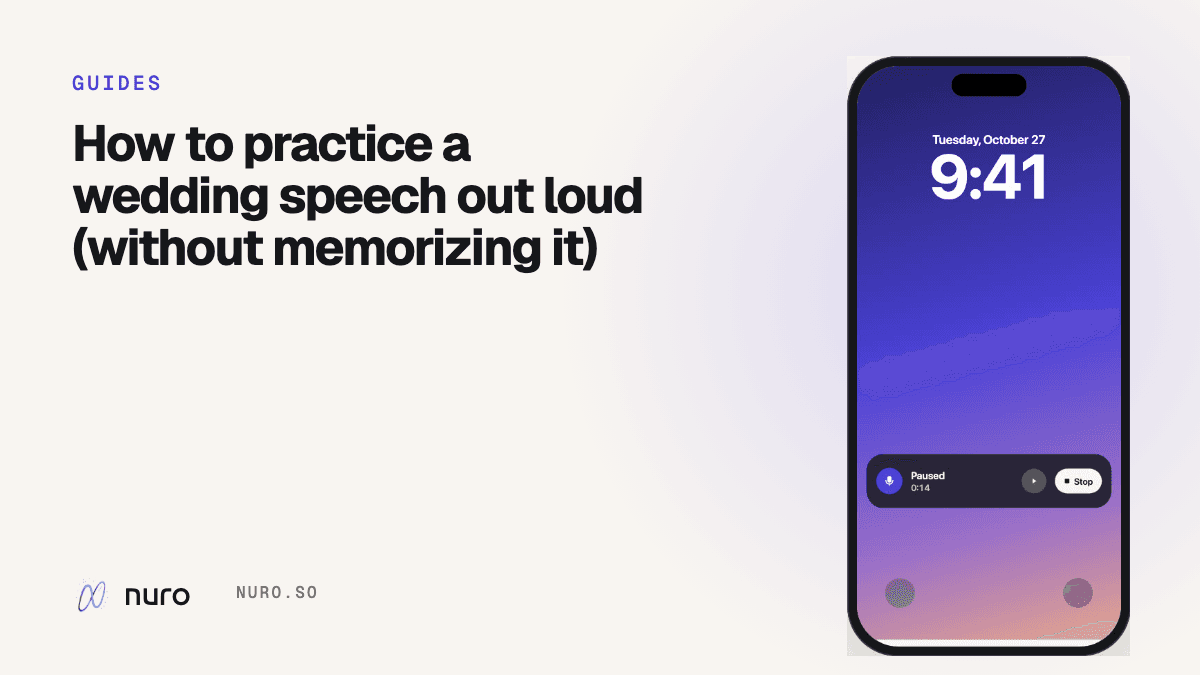
I make Nuro, so weigh this accordingly. I've seen people use it for exactly this: one recording per run-through, each kept with a transcript and the audio, so the line that worked on Tuesday's walk doesn't get lost by Friday. Any voice memo app with transcripts does the same job. What matters is recording every run.
If the thing that worries you is less the speech and more a conversation around the wedding, the same method works there too: see how to prepare for a difficult conversation.
FAQ
Should I memorize my wedding speech?
Memorize the opening line and the toast, word for word, because those are where nerves hit hardest. For the middle, practice from cue words so it sounds natural.
How many times should I practice a wedding speech?
Roughly five to ten full run-throughs out loud, spread over a week or two, is plenty for most people. Spreading them out matters more than the exact number.
Is it OK to read a wedding speech from notes?
Yes. Notes are better than a speech that freezes halfway. If you read, look up at the end of each sentence and slow down.
How do I stop shaking during a wedding speech?
Slow down, breathe out before you start, and hold the card with both hands. A practiced first line helps most, because once you've started, the nerves usually ease.
Related reading: How to prepare for a difficult conversation · How to start a voice journal · Why do I get my best ideas in the shower?