
The most reliable way to stop thinking about work in the evening is to give every loose end a plan before you leave. Spend five minutes saying out loud what's left, what you're waiting on, and the first thing you'll do tomorrow, put that somewhere you'll see in the morning, then end with the same phrase every day.
You don't have to finish everything. You have to decide when each unfinished thing gets picked up.
Why work follows you home
Most evenings when work keeps intruding, it isn't the big projects. It's the small open loops: the reply you didn't send, the numbers you're still waiting for, the slide deck that's half done.
There's a useful study on this. Masicampo and Baumeister (2011) ran a series of experiments in which unfinished goals kept intruding on people's thoughts and made them worse at unrelated tasks. When participants were allowed to make a specific plan for those goals, the intrusions largely went away, even though the goals were still unfinished.
That's the core idea behind a shutdown ritual. Not finishing. Planning.
A note on the Zeigarnik effect. You'll see it cited in almost every article on this topic, usually as "your brain remembers unfinished tasks better". The original findings have had mixed results when other researchers tried to repeat them, so I'm not leaning on it here. The plan-making finding above is more useful anyway, because it tells you what to do.
Credit where it's due: Cal Newport's shutdown ritual
The best-known version of this comes from Cal Newport, who described his work shutdown ritual on his blog in 2009 and later in his book Deep Work. His steps, roughly:
- Move anything he'd jotted down during the day into his master task lists.
- Review those lists and set dates for anything urgent.
- Check his calendar for the next two weeks.
- Review his weekly plan.
- Say a fixed phrase to mark the end of the workday.
If you already have a task system you trust, his version is excellent and you should just use it.
What follows is for people whose "system" is mostly their head. It's the same idea in a lighter form: spoken, five minutes, no lists to maintain beforehand.
The five-minute spoken shutdown
1. Close the laptop first. Do the ritual after, not while you're still answering one more message.
2. Say what's left. Every unfinished thing, out loud, in any order. Don't explain it. Just name it.
3. Say what you're waiting on, and from whom. These are the loops you can't close yourself, and they're often the ones that nag most.
4. Say the first thing you'll do tomorrow. One thing. This is the plan part, and it's what lets your brain put the rest down.
5. Say how the day went, if you want. One line. It's not a task, and it doesn't need to become one, but naming it can help you leave it at work.
6. Put it where you'll see it tomorrow. A note, a list, a voice recording you'll actually open, a sticky note on your keyboard. If it isn't somewhere you trust, your brain will keep holding it for you.
7. End with the same phrase. Newport uses his own. Yours can be anything: "Done for today." What matters is saying it every time.
The whole thing usually takes two to five minutes.
A worked example
It's 5:42 pm. The laptop's closed. You say:
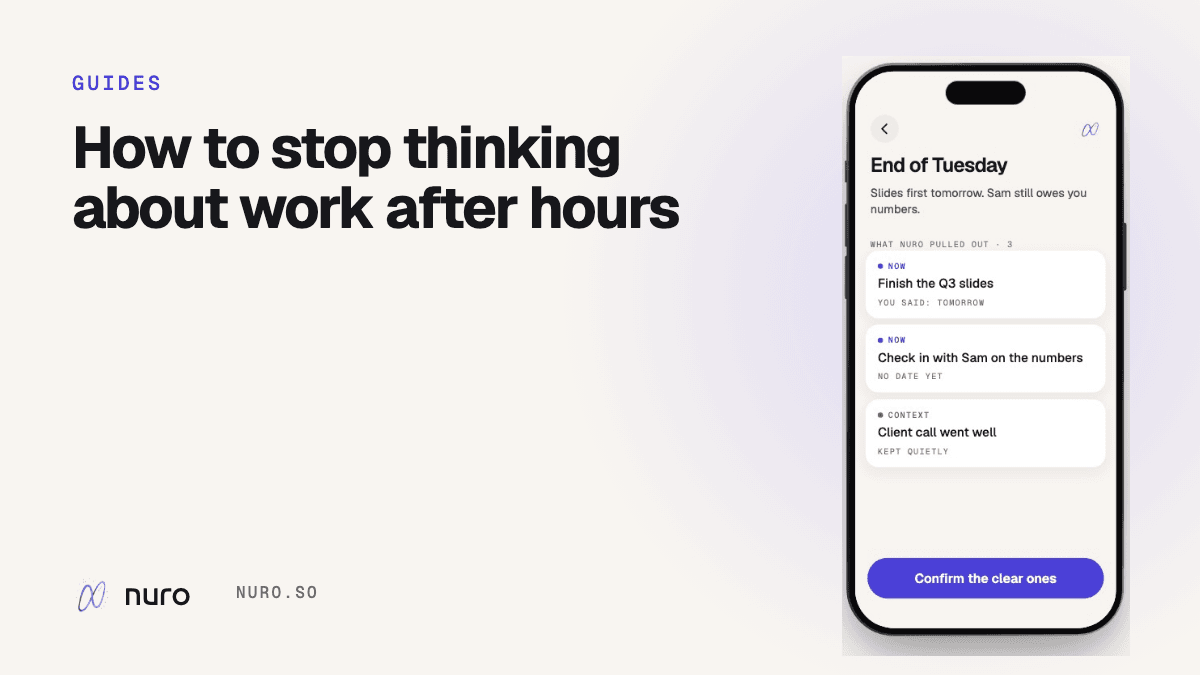
"Done for today. Tomorrow, first thing, finish the Q3 slides. Still waiting on Sam's numbers. Good day, honestly. The client call went well."
Sorted, that's:
| What you said | What it is | When |
|---|---|---|
| Finish the Q3 slides | Something to do | Tomorrow, first thing |
| Still waiting on Sam's numbers | Something to do: check in with Sam | No date yet |
| The client call went well | Just a feeling, worth keeping | Not a task |
Notice what's not there. No deadline invented for Sam's numbers. No "prepare more for client calls" turned out of a good day. Just the loose ends, each with a when, and a note about how the day felt.
When you start thinking about the slides at 9 pm, the answer is already decided: tomorrow, first thing.
When a work thought comes back anyway
It will, sometimes. A few things that help:
- If it's something you already said, remind yourself it's handled. "That's tomorrow's first thing." Then let it go.
- If it's new, add one line to wherever you put the shutdown. Don't open the laptop to deal with it.
- If it keeps coming back, it probably needs a clearer next step. "Deal with the Sam thing" is vague. "Message Sam at 9:30 about the numbers" is a plan.
A bedtime version
If work thoughts show up at bedtime rather than at 6 pm, the same idea works at night. In one study by Scullin and colleagues (2018), 57 young adults spent five minutes writing before sleeping in a sleep lab. Those who wrote a to-do list for the coming days fell asleep about nine minutes faster, on average, than those who wrote about tasks they'd already finished. More specific lists went with falling asleep faster.
It's one small study, and it was about writing rather than speaking. But it points the same way: before bed, list what's ahead, not what you did.
Making it stick
- Same time, same trigger. Tie it to closing the laptop, leaving the building, or getting in the car (before you start driving).
- Keep it short. If it turns into a 20-minute planning session, you'll stop doing it.
- Skip the guilt on bad days. A messy shutdown is better than none.
When a ritual won't fix it
Being honest: if the real problem is that your job expects you to be reachable every evening, or there's simply more work than hours, a shutdown ritual won't solve that. It helps with the loose ends that follow you home. It can't make a workload smaller. If that's where you are, it might be worth thinking through bigger questions, and this guide on deciding whether to quit is one place to start.
Where Nuro fits
I make Nuro, so weigh this accordingly. A spoken shutdown is one of the things it's good at. You talk for a minute or two, it transcribes and keeps the audio, and the entry opens with a one-line summary. It suggests to-dos and keeps the rest as context, and nothing lands on your list until you confirm it. If you didn't say a date, like with Sam's numbers, it doesn't invent one. Your confirmed to-dos wait on your Open list, grouped by Today, This week, Later and No date yet. They won't nag you in the evening.
But the ritual is what matters, not the tool. Close the laptop, say what's left, decide tomorrow's first thing, and call it done.
Related reading: How to brain dump · How to do a brain dump when you have ADHD · What a brain dump app is for · The science of thinking out loud