
To brain dump, set a timer for five to ten minutes and get every single thing in your head out, on paper or out loud, without sorting or judging any of it. Then do the part most guides skip: go through what you got out and sort each item into one of three piles. Something to do, something to remember, or just a feeling.
The dump clears your head. The sort is what makes it still useful tomorrow.
What a brain dump is (and isn't)
A brain dump is capture first, sort second. That's the whole idea.
It isn't journaling for insight, and it isn't planning your week. You're not trying to write anything good. You're emptying a drawer onto the table so you can see what's in it.
Most people do one when their head feels crowded: too many small things competing for attention, none of them big enough to deal with right now, all of them loud enough to keep coming back.
Why getting it out helps
There's a useful finding behind this. In a set of studies by Masicampo and Baumeister (2011), unfinished goals kept intruding on people's thoughts while they tried to do something else. When participants were allowed to make a specific plan for those goals, the intrusions mostly went away, even though the goals themselves weren't done yet.
That's the honest case for a brain dump. Writing or saying things out loud gets them in front of you. But the relief seems to come from deciding what happens to each one. Which is why the sorting step matters so much.
The classic method: pen and paper
This is the version almost every guide describes, and it works well.
- Get a blank page and a timer. Ten minutes is plenty. Five is fine.
- Write everything as a list. Tasks, worries, half ideas, names, errands. One line each.
- Don't organize while you write. No headings, no priorities, no crossing out.
- Keep going past the first lull. There's usually a pause around the two or three minute mark, then a second wave of smaller, more specific things. Those are often the ones that were nagging you most.
- Stop when the timer ends, even if you're not sure you got everything.
Paper is a good choice if you like physically crossing things off, want to keep your phone out of the bedroom, or think better with a pen in your hand. Its main drawback is speed: most people think much faster than they write, so thoughts pile up while your hand catches up.
The spoken version
Same rules, out loud. Talk for five minutes, into a voice recorder or an app, and say everything in whatever order it arrives.
Why some people prefer it:
- There's no blank page. You don't have to find a first sentence. You just start talking.
- It keeps up with you. Speaking is closer to the speed you think, so less gets lost.
- You can do it while moving. Walking, doing the dishes, folding laundry.
A few things make a spoken dump work better:
- Say dates when you know them ("before June", "on the 27th"), and admit it when you don't ("sometime soon, no idea when").
- Don't fix yourself mid-sentence. Messy is fine. Nobody's grading it.
- End with "that's it" so you know where the dump stops.
The honest downside: a spoken dump is harder to scan afterwards. A voice memo you never listen to again is just a quieter version of the thoughts you started with. Whatever you record into, you still need to do the sort.
What to do after the dump
Here's a real-sounding five minute dump, all in one breath:
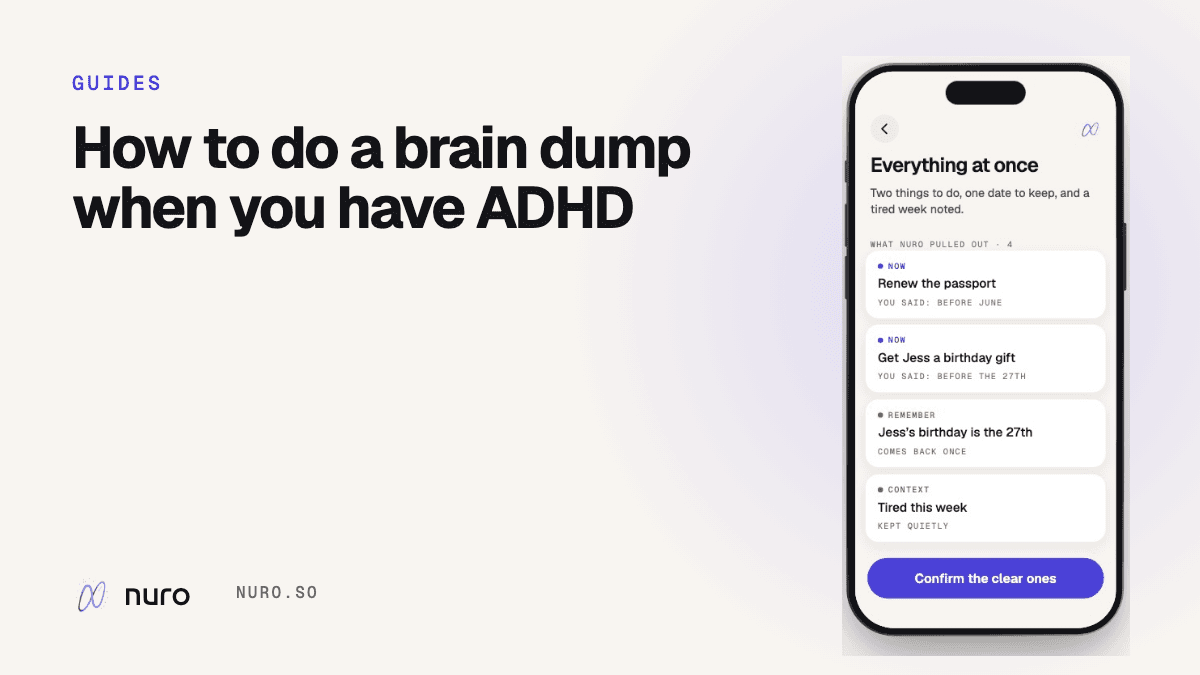
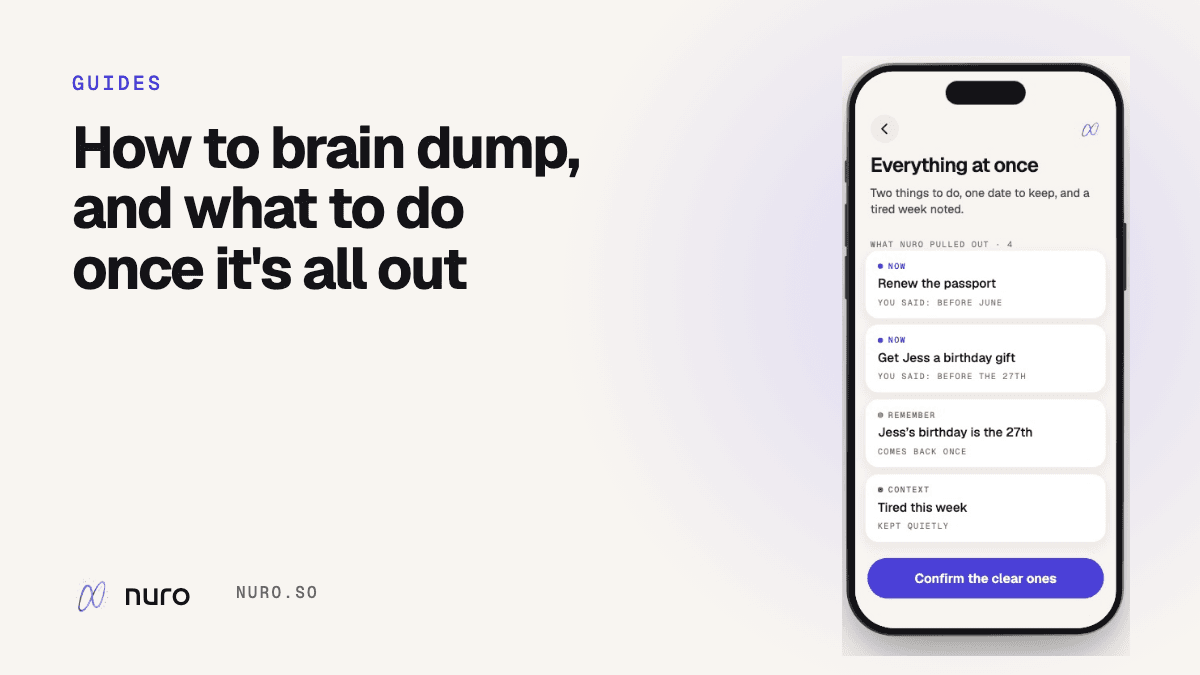
"Renew the passport, it runs out in June. Call Mom back. Jess's birthday is the 27th and I still need a gift. Oh, and that gym idea. Honestly I'm just tired this week."
Go through it and ask one question of each item: what kind of thing is this?
| Pile | What goes in it | From the example |
|---|---|---|
| Do | Something you need to act on | Renew the passport (before June). Call Mom back. Get Jess a gift (before the 27th). |
| Remember | A fact or date you need later, not a task | Jess's birthday is the 27th. |
| Just a feeling | Background, mood, things you noticed | Tired this week. |
Then a few small decisions:
- Give each "do" a rough when. Today, this week, later, or "no date yet". Don't invent a deadline you didn't have. "No date yet" is an honest answer.
- Put each "remember" where you'll see it before it matters. A calendar, a note, a sticky on the fridge.
- Leave the feelings alone. "Tired this week" is worth noticing. It is not a task. Turning it into "fix my sleep" just gives you another thing to feel behind on.
- Decide what an idea is. "That gym idea" might be a to-do, or it might be something you're not ready to act on. It's fine to keep it as a note and decide later.
That's it. You don't need a system with colors and tags. Three piles and a rough when is enough for most days.
Variations
Brain dumping your thoughts in general
The basic method above. Use it whenever your head feels crowded, not on a schedule unless you want one.
Brain dump for anxiety
A brain dump can help when worries are spinning, mostly by getting them out where you can look at them. When you sort, add one more question for each worry: is there anything I can actually do about this? If yes, it goes in the "do" pile with a small next step. If no, it's a feeling, and it's allowed to just sit on the page.
This is a coping habit, not a treatment. If anxiety is constant or getting in the way of your life, a doctor or therapist is the right person to talk to.
Brain dump before bed
There's one study worth knowing about here. Scullin and colleagues (2018) had 57 young adults spend five minutes writing before sleeping in a lab. The group who wrote a to-do list for the coming days fell asleep faster, about nine minutes faster on average, than the group who wrote about tasks they'd already finished. More specific lists went with falling asleep faster.
It's a single small study, and it was about writing, not speaking. But it's a good reason to make your bedtime dump forward-looking: what's left, not what you did.
How to brain dump effectively
- Keep it short. Five minutes done often beats thirty minutes done once.
- Be specific. "Email Sam the numbers by Thursday" is easier to put down than "work stuff".
- Always do the sort, even if it's thirty seconds.
- Throw away or archive the raw dump once it's sorted. Keeping it is fine. Rereading it every day isn't the point.
For specific situations
- With ADHD: a shorter version built around the step after. How to do a brain dump when you have ADHD.
- At the end of the workday: a five minute spoken shutdown. How to stop thinking about work after hours.
- Before a hard conversation: dump what you're worried they'll say, then rehearse. How to prepare for a difficult conversation.
- When you're deciding whether to leave a job: Should I quit my job?
Common mistakes
- Sorting while you dump. It slows you down and you start censoring. Get it all out first.
- Turning everything into a task. Feelings and facts aren't tasks. A list full of "be less tired" isn't a list you'll use.
- Inventing deadlines. If you didn't have a date, don't make one up just to fill the column.
- Skipping the sort entirely. Then you have a page (or a recording) of the same thoughts that were in your head, just somewhere else.
Where Nuro fits
I make Nuro, so weigh this accordingly. Nuro is the spoken version with the sort done as suggestions. You talk (or type when you can't), it transcribes and keeps your audio, and every new entry opens with a one-line summary. Then it suggests what it found in three kinds: to-dos, things to remember, and context, which it keeps but never turns into a task. Nothing goes on your list until you confirm it, and if you never said a date, it doesn't invent one.
You don't need an app to brain dump well, though. A pen, a timer and three piles will get you most of the way.
Related reading: What a brain dump app is for · Voice journaling vs writing · The science of thinking out loud · Best brain dump apps