
The short version: talk for three to five minutes instead of writing, say every single thing in your head without sorting it, then spend two minutes on the step after. That step is asking of each item: is this something to do, something to remember, or just a feeling? Then pick one thing for today.
Quick note before the rest: this is a productivity guide, not medical advice. If ADHD is affecting your life, a doctor or ADHD specialist is the right person to talk to.
Why a brain dump can help
Think of it as taking load off your working memory: the part of your mind that holds things while you use them.
- A 2013 meta-analysis by Alderson and colleagues found that adults with ADHD, on average, show working memory difficulties compared with adults without it.
- A 2001 study by Klein and Boals found that college students who did expressive writing about stressful experiences had more working memory capacity weeks later than those who wrote about neutral topics.
To be clear about the limits: neither study is about brain dumps, about speaking, or (in Klein and Boals' case) about ADHD. They just support a sensible idea. Things you're trying to hold in your head take up room, and putting them somewhere outside your head can free some of it.
Why speaking can beat the blank page
Most brain dump guides start with "grab a pen and paper". If a blank page makes you freeze, that's a bad start.
Speaking helps because:
- No first sentence. You just start talking.
- It keeps pace. Thoughts don't pile up waiting for your hand.
- You can move. Pace the kitchen, walk the dog, fidget all you want.
- Losing the thread is fine. "Wait, what was I saying" is a perfectly good thing to say into a recording.
Any voice recorder works. The catch is that a recording you never revisit doesn't help much, which is why the step after matters.
The five-minute version
- Hit record. Phone, Watch, whatever is closest.
- Say everything. Tasks, people, worries, half ideas. Any order.
- Don't sort, don't fix. Messy is the point.
- Say dates if you know them. "Before June." "On the 27th." If you don't know, say that.
- Stop at five minutes or when you run dry. Say "that's it".
Stuck? Try these out loud:
- What's due soon?
- Who am I supposed to get back to?
- What am I avoiding?
- What's bugging me today?
A worked example
Here's a real-sounding dump, all in one go:
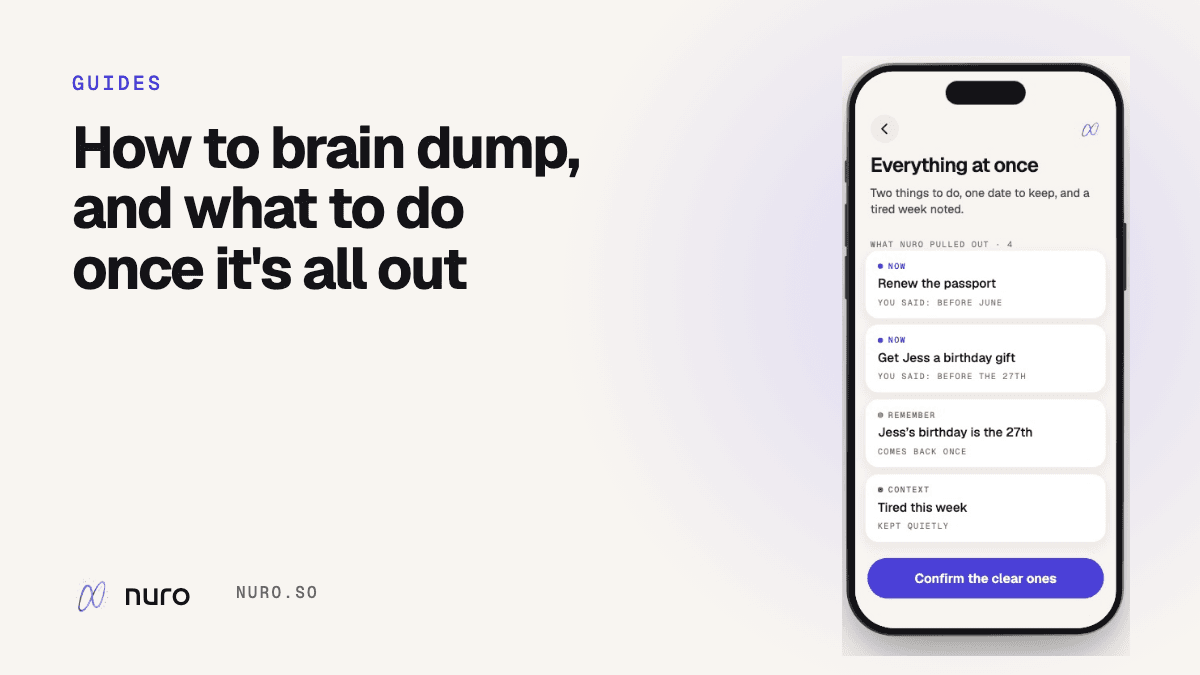
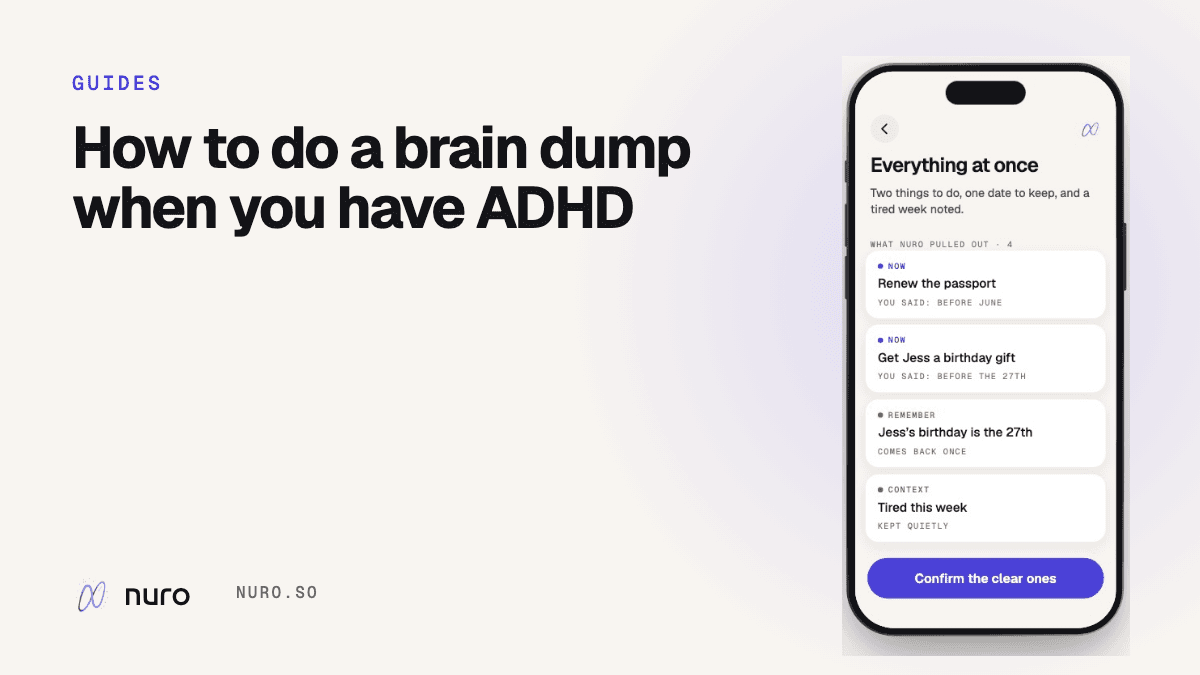
"Renew the passport, it runs out in June. Call Mom back. Jess's birthday is the 27th and I still need a gift. Oh, and that gym idea. Honestly I'm just tired this week."
Five things, three different kinds. That's normal.
The step after the dump
This is the part most guides skip, and it's the part that makes the dump worth doing. Go through once and ask one question per item.
Is it something to do?
- Renew the passport (before June)
- Call Mom back
- Get Jess a gift (before the 27th)
Is it something to remember?
- Jess's birthday is the 27th
Is it just a feeling?
- Tired this week
Is it an idea you're not ready to decide on?
- That gym idea. Park it. An idea isn't a task until you decide it is.
Then:
- Give each to-do a rough when: today, this week, later, or no date yet. Don't invent deadlines you didn't have.
- Pick one thing for today. Just one. Calling Mom back takes two minutes, so that's a good pick.
- Leave the feeling alone. "Tired this week" doesn't need to become "fix my sleep". Noticing it is enough.
When the dump feels too big
Sometimes you hit record and everything comes out at once, and the list is long enough to feel worse than before. A few ways through:
- Sort only the top five. You don't have to sort everything today. The rest stays captured.
- Ask "what happens if I don't?" for each to-do. Anything with no real consequence this week can go to "later" or "no date yet".
- Pull out the two-minute ones. Calling Mom back, sending one text. Do one right away. Getting one thing done often makes the rest feel smaller.
- Notice the feelings. If half the dump is "stressed", "behind", "tired", that's useful to know. It might mean the list isn't the problem today.
Making it a habit (without a streak)
You don't need to do this daily. Most people find a brain dump helps most when their head feels crowded, not on a schedule.
If you do want a rhythm, tie it to something you already do: making coffee, the walk home, brushing your teeth. Keep it to five minutes so skipping a day doesn't feel like a big loss. Missing a week doesn't mean the method failed. It just means you haven't needed it, or you forgot, and both are fine.
One more tip: record wherever the thought shows up. If your best ideas arrive mid-walk, a short recording on your phone or watch beats trying to remember it at home.
What to skip
- Elaborate templates. If setting up the system takes longer than the dump, you won't do it again.
- Color coding and tags. Three piles is enough.
- Doing everything on the list today. The dump was to get it out of your head, not to sign up for all of it at once.
- Redoing the dump because it felt messy. Messy dumps still work.
Where Nuro fits
I make Nuro, so weigh this accordingly. It's built for exactly this shape of entry: you talk, it transcribes and keeps the audio, and the entry opens with a one-line summary. Then it suggests to-dos, things to remember and context, sorted for you. Nothing goes on your list until you confirm it, and it won't invent a date you didn't say.
A couple of things that may matter if you have ADHD: to-dos never get reminders or nags. If an undated one has been sitting for 21 days, Nuro asks "Still true?" once, and never again. There's more on that on the voice journal for ADHD page.
But you don't need an app for any of this. Talk, then sort into three piles. That's the whole method.
Related reading: How to brain dump (the full guide) · How to stop thinking about work after hours · The science of thinking out loud · Voice journal for ADHD