
If you can't sleep because you keep thinking about tomorrow, spend five minutes before bed listing what you need to do over the next few days, as specifically as you can. In one sleep-lab study, people who did this fell asleep faster than people who spent the same five minutes writing about tasks they'd already finished, and the more specific the list, the faster they fell asleep.
It's one small study with healthy young adults, so treat it as a promising, cheap thing to try, not a cure.
What the study actually did
The study is Scullin and colleagues (2018), published in the Journal of Experimental Psychology: General. It's often summarized as "to-do lists help you sleep", which is roughly right but skips the details that matter.
| Detail | What the study did |
|---|---|
| Who | 57 healthy adults aged 18 to 30, with no sleep problems |
| Where | One night in a sleep lab, with sleep measured by polysomnography (brain waves, not self-report) |
| What they did | Five minutes of writing just before lights out |
| Group 1 | Wrote a to-do list: tasks they needed to remember to do over the next few days |
| Group 2 | Wrote about tasks they had completed over the previous few days |
| Main result | The to-do list group fell asleep significantly faster |
| Size | Roughly 15 minutes versus 25 minutes on average, as the British Psychological Society's summary rounds it |
| Extra finding | The more specific people's to-do lists were, the faster they fell asleep. The opposite trend showed up for people writing about completed tasks |
That last finding is the useful one. It wasn't just "write anything". Specific lists ("email Priya the venue options before 10") went with falling asleep faster than vague ones ("work stuff").
What it doesn't show
Being careful here, because this study gets stretched a lot online.
- There was no "no writing" group. The comparison was to-do lists versus completed-task lists. So it can't tell you whether a to-do list beats doing nothing. It's possible that writing about finished tasks slowed people down, rather than to-do lists speeding them up. The BPS summary makes the same point.
- These were good sleepers. In Baylor's announcement, Scullin said they don't know whether the findings would carry over to people with insomnia, and the release notes that a larger study would be of value.
- It was one night, in a lab. Not weeks at home.
- It was writing, not speaking. No one has tested a spoken bedtime list that I could find. I think the logic carries over, but that's my view, not a finding.
So the honest version is: one well-measured study, a meaningful difference, and a very low-cost thing to try.
Why a list might help
The authors' explanation is that writing tasks down offloads them. Your mind stops rehearsing them because they're held somewhere else.
That fits another line of research I've written about in how to stop thinking about work after hours. In Masicampo and Baumeister (2011), unfinished goals kept popping into people's heads until they made a specific plan for them, even though the goals were still unfinished. The plan was enough.
At 11 pm, that's exactly the problem. Tomorrow isn't happening yet, so you can't finish anything. You can only decide when each thing gets picked up.
How to make your bedtime list work
Based on the specificity finding, a few things seem to matter:
- Look forward, not back. List what's ahead, not what you did today. Save "how today went" for earlier in the evening, if you want it at all.
- Be specific. "Call the garage about the brakes at 9" beats "car". Name the person, the thing, and when.
- Cover the next few days, not just tomorrow. The study asked about the next few days. Things due on Thursday can keep you up on Monday.
- Keep it to five minutes. This is a list, not a planning session. If it turns into reorganising your week, stop and do that tomorrow.
- Put it somewhere you'll see in the morning. If you don't trust the list to be there, your brain will keep holding it for you.
Try it out loud: the three-minute tomorrow list
The study used writing. If you'd rather talk, here's a spoken version. Do it before you get into bed, then put the phone down.
- Say "Tomorrow and the next few days" and start listing. One item per sentence. Don't explain, just name it.
- Add a when to each one. "Email Priya the venue options, before 10 tomorrow." "Book the vet, Wednesday." If there's no real when, say "no date yet". That still counts as a decision.
- Name anything you're waiting on. "Still waiting on Tom's quote." These are often the ones that nag.
- Say the first thing you'll do in the morning. One thing.
- End with the same line every night. "That's the list." Then stop.
If a new thought arrives once you're in bed, add one line to the list and go back to sleep. Don't start a second round.
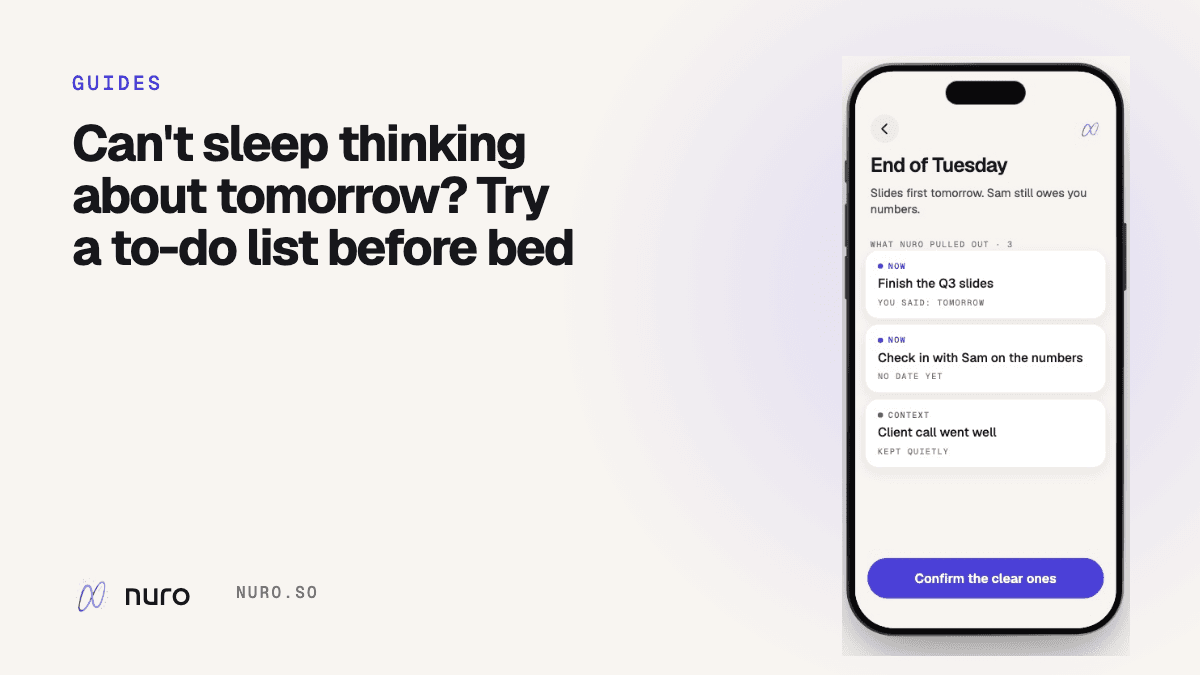
Here's the same idea earlier in the evening, as an end-of-work version:
I make Nuro, so weigh this accordingly. When you say your list into it, Nuro transcribes it and pulls out possible to-dos and the days you named, for you to confirm. A to-do with a day you named can remind you on that day, so "book the vet, Wednesday" doesn't need to live in your head until Wednesday. Any notes app or a pad by the bed works too. The list is what matters.
When a list isn't enough
If you lie awake most nights, or poor sleep has been going on for a while, a bedtime list probably won't fix it on its own. The NHS advises seeing a GP about insomnia if changing your sleep habits hasn't helped, if you've had trouble sleeping for months, or if it's making daily life hard to cope with. That's worth doing. It's not a failure of the list.
And if what keeps you up is a feeling rather than a task (dread about a conversation, say), a list won't touch it. Naming the feeling might help a little; I wrote about the research on that in name it to tame it.
FAQ
Should I write down my worries or my to-dos before bed?
The Scullin study tested to-dos, not worries, so to-dos have the better evidence. If a worry has a next step ("ask the landlord about the leak"), turn it into a to-do with a when.
Does it matter if I use paper or my phone?
The study didn't compare them. If you use your phone, make the list before bed and then put the phone away, rather than lying there scrolling afterwards.
How long before bed should I make my to-do list?
In the study, people wrote for five minutes right before lights out. Doing it close to bedtime, and keeping it short, is the closest match to what was tested.
Will a bedtime to-do list help with insomnia?
Nobody knows yet. The study only included good sleepers, and the researchers said so. If sleep is a long-running problem, talk to a doctor.
Related reading: How to stop thinking about work after hours · How to brain dump · Name it to tame it