
To prepare for a difficult conversation, rehearse it out loud, alone, once. Say your purpose in one sentence, say your opening line, say your ask, then say your answer to the worst thing they could reply. Listen back, write down the two or three things you want to remember, and stop.
That last step matters as much as the others. Rehearsal has an end. Replaying a conversation in your head at 1 am does not.
Why "just practice" is not enough
Almost every guide to difficult conversations says to practice. Very few say how, and the default most of us fall back on is running the conversation silently in our heads, over and over, usually while trying to sleep.
Silent rehearsal has two problems. First, it loops. Your mind jumps to the worst moment, replays it, and jumps back without ever finishing a sentence. Second, it flatters you. In your head your opening line sounds calm and clear. Out loud, it can come out as a three-minute apology before you get anywhere near the point.
Saying it out loud forces whole sentences, in order, with a beginning and an end. You hear where you ramble, where you soften the ask until it disappears, and which word you trip over every time.
There is also some research worth knowing, described modestly. In one brain-imaging study (Lieberman and colleagues, 2007, about 30 people), putting a feeling into words was linked with a calmer response in the brain's threat system than simply looking at the trigger. It was a lab study about labeling emotions, not about rehearsing conversations, but it fits what many people notice: saying "I'm nervous he'll be hurt" out loud takes some of the charge out of it. If you want more of the background, I wrote about it in the science of thinking out loud.
The method: eight steps, about ten minutes
Find somewhere you can talk without being overheard. A parked car, a walk, an empty room. Record yourself on your phone if you can. You will want to hear it back.
-
Say your purpose in one sentence. Not the whole history. What do you want to be true when the conversation is over? "I want Marco to know I can't host this year, and I want us to still be fine." If you can't fit it in one sentence, you have two conversations, and you should pick one.
-
Name what you're feeling. One or two words, out loud. "Guilty. A bit scared he'll go quiet on me." This is not the conversation. It is clearing your throat so the feeling doesn't do the talking later.
-
Say your opening line. The first thing out of your mouth, word for word. Aim for one or two sentences that get to the point. Most hard conversations go wrong in the first 30 seconds, when we circle the subject for so long the other person starts guessing.
-
Say the ask. What, specifically, do you want from them? A change, a decision, a yes, or simply that they hear you. Say it plainly. If you notice yourself adding "only if that's okay" three times, say it again without the padding.
-
Say the worst reply you can imagine, then your answer. Play their part for a moment. "You always do this." "So it's on me, then?" "We'll talk about this later." Then answer it, out loud, calmly. You only need one answer per reply, and usually one or two replies cover most of what you fear.
-
Listen back once. Play the recording all the way through, one time. You are listening for three things: where you lost the point, the phrases that sound like you (keep those), and the phrases that sound like a script (drop those).
-
Note what you want to remember. Two or three things at most. Your opening line, your ask in one sentence, and maybe one fact you don't want to forget in the moment. Write them down or keep them on your phone.
-
Stop. You're done. Don't do a second take unless the first one fell apart. One good pass is preparation. Ten passes is the replay loop with a microphone.
A worked example
Here's how it sounds for one real-shaped conversation: telling your brother Marco that you can't host the family holiday this year, the first time in six years.
- Purpose: "I want Marco to hear that I'm not hosting this year, and I want him to know it's not about him."
- Feeling: "Guilty. And worried he'll make a joke and then not call for a month."
- Opening: "Marco, I need to tell you something about the holidays before Mom starts planning. I can't host this year."
- The ask: "Would you be up for hosting, or should we find somewhere together?"
- Worst reply: "Great, so now it's my problem." Answer: "I get that it lands on you, and I'm sorry about the timing. I'll still bring the food and help with the cleanup. I just can't have it at mine this year."
- Listen back: the opening was fine. The answer to the worst reply had four apologies in it. Cut to one.
- Remember: call before Mom starts planning; offer to bring the food.
That took about eight minutes. The conversation itself might take five.
Why stopping helps if you replay conversations endlessly
Some people search for how to prepare for a hard conversation. Others search for how to stop replaying one. Often they're the same person, before and after.
Replaying is what the mind does with something unfinished. It keeps reopening the conversation because it doesn't know what you've decided. A rehearsal with a defined end gives it a different answer: this has been thought through, the opening line exists, the ask is written down, and there's an answer to the worst reply.
When your mind drifts back to it later, you don't need to run the whole thing again. Look at your two or three notes and let that be enough.
Two small extras, if they help:
- Talk to yourself by name. In a 2014 set of studies, Kross and colleagues found that people who prepared for a stressful speech using their own name or "you" ("you can do this") were rated as giving better speeches, and dwelled on it less afterwards, than people who used "I". Try your purpose sentence in the second person: "You want Marco to know it's not about him."
- Call the nerves excitement. In one series of experiments, Alison Wood Brooks found that people who said "I am excited" before public speaking or singing did better than people who tried to calm down. Nerves and excitement feel similar in the body. You don't have to pretend you're calm.
Variants: work, partner, family
The eight steps stay the same. What changes is what tends to go wrong.
At work (your manager, a colleague, someone you manage). Lead with the fact, not the feeling. "The launch date won't hold. Here's what I can deliver by then." Prepare one specific example, because "you always" goes nowhere at work. For the worst reply, rehearse "Why am I only hearing this now?" because it comes up a lot.
With a partner. The opening line matters most here, because partners hear tone before words. Start with what you want for the two of you, not with the complaint. "I want us to stop fighting about weekends, so I want to talk about how we split them." For the worst reply, rehearse the one that stings ("You're overreacting") and practice an answer that doesn't escalate.
With family. Old roles show up fast. You can be 40 and still get talked to like the youngest. Keep your ask very short and repeatable, so you can say it a second time without adding a defence. Decide ahead of time what you'll do if the conversation turns into a different, older argument: "I don't want to get into that today. I just wanted to tell you about this year."
After the conversation: two minutes, then let it go
Once it's over, do a short spoken debrief instead of a silent replay. Out loud: what happened, what was decided, anything you now need to do, and how you feel. Two minutes. Then you have a record, and you can stop carrying it.
If something needs following up ("send Marco the dates", "ask Mom about the ham"), that's the moment to catch it.
Where Nuro fits (and where it doesn't need to)
I make Nuro, so weigh this accordingly. You can do every step above with any voice recorder, including the one already on your phone. If you just want to hear yourself back, Apple Voice Memos works fine.
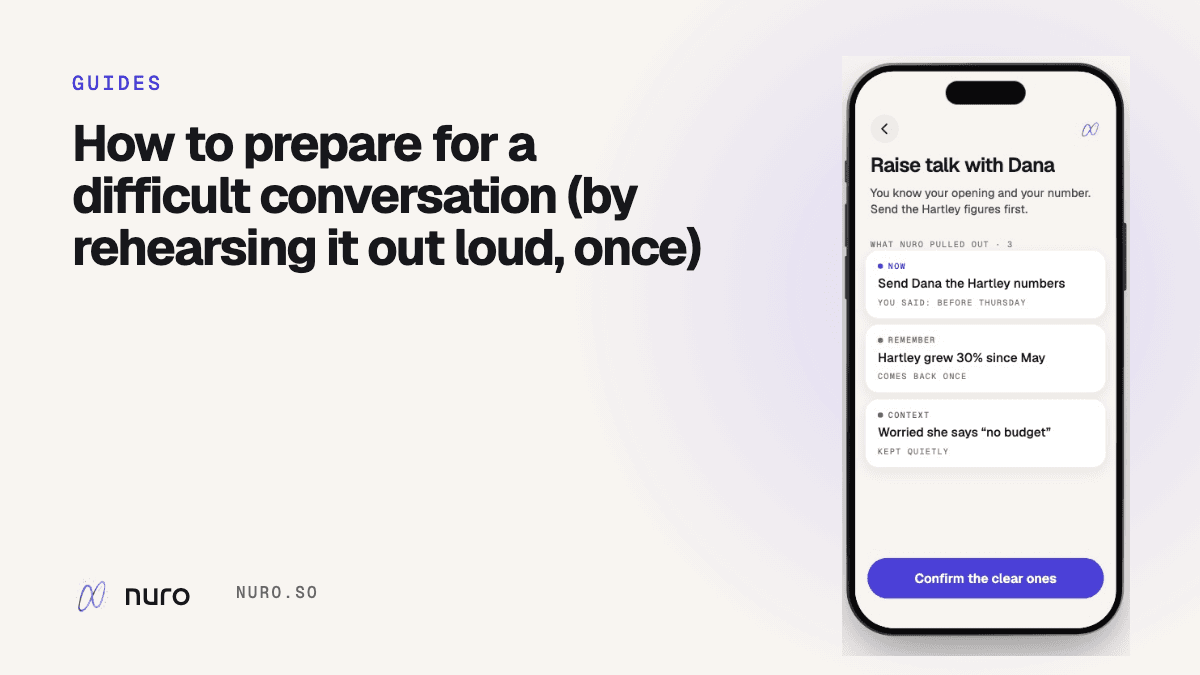
What Nuro adds is what happens after you stop talking. It transcribes the rehearsal and keeps the audio next to the transcript, so you can read your opening line or replay how you actually said it. Each entry opens with a one-line summary. Then Nuro suggests what it found, sorted into to-dos, things to remember, and context (like the worry you voiced, which it keeps but never turns into a task). Nothing goes on your list until you confirm it.
That example is a different conversation, a pay talk. If that's the one in front of you, there are scripts for it in what to say when asking for a raise.
Related reading: What to say when asking for a raise · Should I quit my job? · The science of thinking out loud · Voice journaling vs writing