
There's no quiz that can tell you whether to quit your job, because it doesn't know your work, your money or what's really going on. What can help is answering a handful of honest questions out loud, recording yourself, and listening back. Most people hear something they already knew but hadn't said yet.
Below are eight questions, how to do the exercise in about 20 minutes, and what to listen for afterwards. This won't push you either way. Staying is a real answer. So is leaving.
Why talk it through instead of taking a quiz
Quizzes are popular for this, and it's easy to see why. You answer ten questions and get a verdict. The trouble is the questions are written for everyone, so they can't ask about the thing that's actually keeping you up: the one colleague, the commute that doubled, the project you used to love that got taken away.
Thinking about it silently has its own problem. The same three thoughts go round and round, and every time you get close to a conclusion, a "but what about..." sends you back to the start.
Talking forces you to finish sentences. You have to say what's wrong in actual words, in an order, and you can hear when an answer comes out firm and when it comes out shaky. That shakiness is information.
How to do the exercise
Find 20 minutes and somewhere private. A walk works well. Record yourself on your phone.
Go through the questions below in order. Say your answer out loud, as long or short as it needs to be. Don't edit as you go, and don't try to sound reasonable. Nobody else will hear this unless you choose to share it.
When you're done, stop. Don't listen back straight away. Give it an hour, or sleep on it.
The eight questions
1. What, specifically, is wrong?
Not "I hate it". What happened in the last two weeks that made you think about quitting? Name the moments. "Monday's meeting where my idea got handed to someone else." "Three weekends in a row answering messages." Specific beats general here, because general feelings are hard to act on.
2. Is it the job, the manager, the work itself, or this season?
These have different fixes. A bad manager might change in six months. A job that has drifted away from the work you like probably won't drift back. A brutal quarter ends. Say out loud which one it mostly is, even if it's a mix.
3. Have you tried to fix it? What happened?
Have you told anyone what you just said in question one? Asked for a different project, a schedule change, a conversation with your manager? If you have and nothing changed, say that. If you haven't, say why not. Sometimes the honest answer is "because I don't think it would matter", and that's worth hearing too.
If there's a conversation you've been avoiding, how to prepare for a difficult conversation walks through rehearsing it. And if part of the problem is pay, what to say when asking for a raise has scripts.
4. Are you running toward something, or away from something?
Both are valid reasons to leave. But they lead to different next steps. Running toward something (a field, a type of work, a city) means you can start testing it now. Running away means it's worth being clear about what you're leaving, so you don't land somewhere with the same problem in a different building.
5. What does the money look like?
Say it plainly. How many months could you cover your costs if you left without another job lined up? What would you cut? Is anyone depending on your income? I'm not going to tell you what number is enough, because that depends entirely on your life. The point is to say the real number out loud instead of letting it sit as a vague fear, or a vague reassurance.
6. What would you tell a friend who said all of this to you?
Imagine someone you care about just described your last five answers. What would you say to them? Most of us are kinder and clearer about other people's lives than our own.
7. Now say it again in the third person
Tell the story about yourself using your name. "Alex is thinking about leaving because..." It feels strange for about ten seconds.
There's a reason to try it. In a 2014 set of studies, Ethan Kross and colleagues found that people who talked to themselves using their own name or "you", rather than "I", saw stressful situations as more of a challenge and less of a threat, performed better, and dwelled on them less afterwards. The studies weren't about career decisions, but the idea carries over: a little distance makes it easier to see your own situation the way you'd see someone else's.
8. A year from now, which would you regret more?
Picture yourself next October having stayed. Then picture yourself having left. Say out loud how each one feels. Don't pick the "right" answer. Notice which one your voice slows down on.
Listening back: what to listen for
After a break, play the whole recording once. You're not grading your answers. You're listening for patterns.
- What did you keep coming back to? If one person, one project or one feeling showed up in four different answers, that's probably the real subject.
- Where did your voice change? Faster, quieter, more certain, close to tears. The answers you rushed through are often the ones that matter.
- What did you not say? If you never mentioned the work itself, only the people, or never mentioned money at all, that's useful to know.
- Did you answer question three? "Have you tried fixing it" is the one people most often skip.
Write down two or three sentences of what you heard. Not a decision. Just what you noticed.
About flipping a coin
You may have heard that flipping a coin helps with big decisions. There's an interesting study behind that, and it's worth describing carefully.
The economist Steven Levitt ran a large online experiment (later published in the Review of Economic Studies in 2021) where people facing hard decisions, including whether to quit a job, flipped a virtual coin. People whose coin said "make the change" were more likely to make it. And people who made a change, such as quitting, reported being happier two and six months later than people who stayed put.
Some honest caveats. These were volunteers who went looking for a coin flip, so they were already genuinely torn. Happiness was self-reported. And it's an average across many people, not a prediction for you. The finding suggests that people who are truly on the fence may be a bit too cautious about change. It does not say that quitting is the right answer.
The more practical takeaway from the coin: when it lands, notice whether you feel relieved or disappointed. That reaction is often clearer than anything you'd get from a list of pros and cons.
Do it more than once
Big decisions rarely get made in one sitting. A good rhythm is to do this exercise, wait a couple of weeks, and do it again. Then compare. Has the main thing changed? Did a fix you tried in between make any difference? Do you sound more sure, or less?
That comparison is where having your earlier answers matters, because memory rewrites things. Two weeks from now you'll remember how you felt in a general way, not what you actually said.
Where Nuro fits
I make Nuro, so weigh this accordingly. You can do all of this with any voice recorder, or with a notebook.
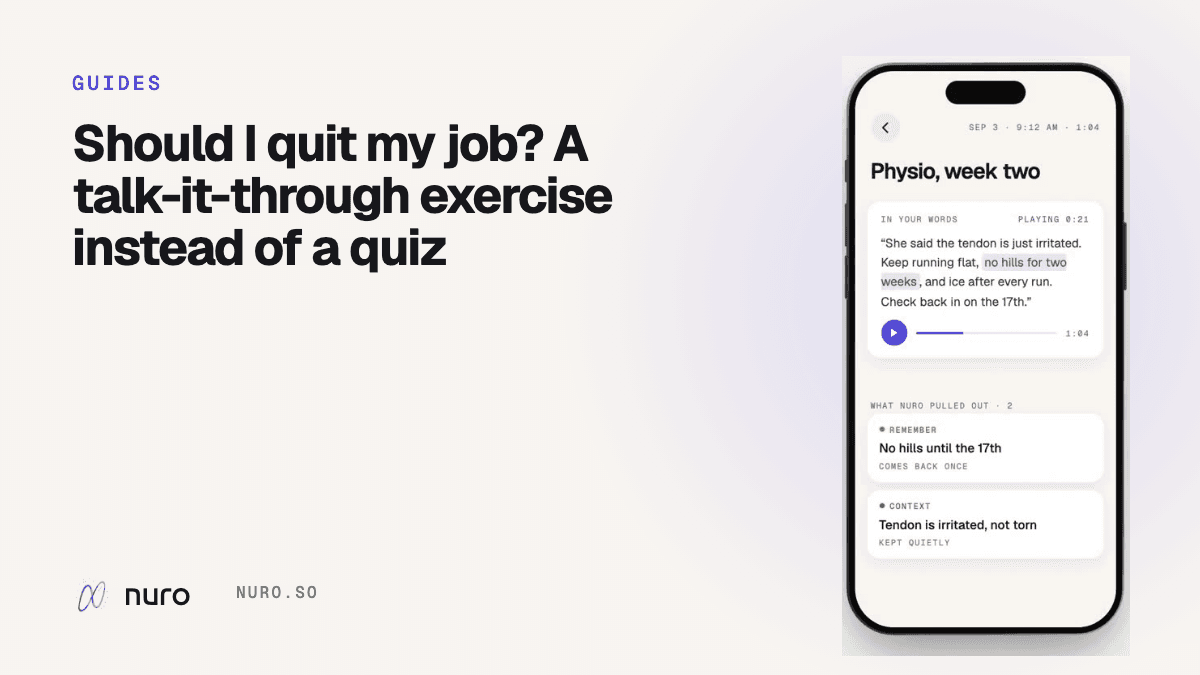
Nuro is an iPhone voice journal. You talk, and it transcribes what you said and keeps the audio with it, so you can replay your own answers later. Library search finds entries by your words and also by meaning, which helps when you remember roughly what you said about your job last month but not when.
Nuro also suggests to-dos and things to remember from what you said, and only keeps the ones you confirm. Feelings stay as context and never become tasks. So if you say "I'm exhausted and dreading Monday", it won't put that on a to-do list. If you say "ask HR how much notice I'd need to give", that might become a to-do once you confirm it.
Whatever you decide
There's no wrong outcome here, only a decision you've actually thought through, or one you haven't. If you hear yourself back and realize you want to stay and fix one thing, that's a good result. If you realize you've been ready to go for months, that's a good result too.
And if work is affecting your sleep, your health or how you feel day to day, please talk to someone you trust, not just a recording.
Related reading: How to prepare for a difficult conversation · What to say when asking for a raise · The science of thinking out loud · Voice journal app