
When you ask for a raise, say three things in order: why you're asking now, the evidence, and the specific number. For example: "I'd like to talk about my pay. Since May I've taken over the Hartley account and it's grown 30%. I'm asking for a 12% raise." Then stop talking and let them answer.
The scripts below cover the opening, the ask, and the two replies that stop most people cold. But a script you read silently the night before will desert you in the room. The last part of this guide is about saying it out loud until it sounds like you.
Before the words: three things to have ready
Scripts only work if what's behind them is solid. Get these three down first.
Your number. A specific figure or percentage, not "a bit more". Look at what similar roles pay where you live using salary sites, job ads that list pay, and people in your field you trust. Pick a number you can explain, then ask for that number. Don't open low hoping to be rewarded for modesty.
Your evidence. Two or three concrete things you've done, with numbers where you have them. Results, responsibilities you've taken on, problems that are gone because of you. "I've worked really hard" is true and doesn't help. "The Hartley account grew 30% since May" helps.
Your timing. Ask when you have something recent to point at, and before budgets are set if you can find out when that is. If you don't know when pay decisions happen at your company, that's a fine question to ask in the conversation itself.
The example we'll use
Say you're meeting your manager, Dana, on Thursday. Since May you've been running the Hartley account, and it's grown 30% in that time. You want a 12% raise. You also know the company does pay reviews in March, so if the answer is "not now", March is your fallback.
Every script below uses that story. Swap in your own names and numbers.
Script 1: asking for the meeting
Don't ambush anyone in a hallway or tack it onto the end of a status meeting. Ask for time specifically.
"Dana, could we get 20 minutes on Thursday? I'd like to talk about my role and my pay."
Saying "pay" up front is a kindness. Dana won't be blindsided, and she has a chance to check what's possible before you meet.
Script 2: the opening
Get to the point in your first two sentences. Long warm-ups make people nervous, including you.
"Thanks for making the time. I want to talk about my compensation. Over the last few months my role has changed quite a bit, and I'd like my pay to reflect that."
Script 3: the evidence
Keep it to two or three points. You're not reading out your whole year.
"Since May I've been running the Hartley account. It's grown 30% in that time. I've also taken on the weekly reporting that used to sit with the team lead."
Script 4: the ask
This is the sentence people blur. Say the number. Then be quiet.
"Based on that, I'm asking for a raise of 12%."
The silence after this line will feel long. Let it. The next person to speak should be Dana.
Replies to the two hardest answers
Most raise conversations don't end in yes or no. They end in one of these. Rehearse your answer to both.
"There's no budget right now"
This is often true, and it's not the end. Your goal is to turn "no budget" into something concrete.
"I understand. Can we agree on what would need to be true for this to happen, and when? The March review is the next point I'd want to come back to."
If money really is frozen, you can also ask about things that cost less up front:
"If the 12% isn't possible now, is there anything that is? A smaller increase now with a review in March, a title change, or a one-off bonus for the Hartley growth?"
"Let's revisit in six months"
Six months is fine if it's real. It needs a date and a target, or it quietly becomes never.
"I'm open to that. Can we put a date on it, say the March review, and agree on what I'd need to show by then? I'll send you a short note after this so we're both working from the same list."
Then send that note. A two-line email after the meeting ("Thanks for today. As discussed, we'll revisit my pay at the March review, and the goals we agreed are...") is the difference between a promise and a conversation you half remember.
Two smaller ones worth a line each
- "What number did you have in mind?" Say your number. "12%." Don't apologize for it or add a range below it.
- "Let me think about it." "Of course. When would be good to pick this back up?" Get a day.
The gap in every script: you freeze
Here's what happens to most people with a good script. They read it on their phone on Wednesday night. It makes sense. On Thursday they sit down across from Dana, and the words come out in the wrong order, the number comes out as "maybe around ten-ish", and the "no budget" reply lands with nothing behind it.
A script read silently is a plan in someone else's voice. Your mouth has never said it. Under pressure, people fall back on what they've actually done, and you haven't actually said any of it yet.
The fix is simple and a little awkward: say it out loud before Thursday.
There's some research behind preparing for specific moments ahead of time. A 2021 meta-analysis of 21 studies (about 15,900 people) looked at a method that pairs thinking about obstacles with "if this happens, then I'll do that" plans. It found a small to medium effect on reaching goals, and the authors note the true effect may be smaller because of publication bias. None of those studies were about raises. But "if Dana says there's no budget, then I'll ask what would need to be true by March" is exactly that kind of plan, and saying it out loud is how it becomes yours.
How to rehearse it in ten minutes
- Say all four scripts out loud, in order, as if Dana were in front of you. Record it on your phone.
- Play Dana. Say "There's no budget right now" out loud, then answer it. Do the same with "Let's revisit in six months."
- Listen back once. Mark any phrase you'd never say in real life and replace it with how you'd say it. If you'd never say "compensation", say "pay".
- Do one more pass with your own wording. Stop when it sounds like you talking, not you reading.
- Write down what you need. The number. The Hartley figure. The March fallback. Anything you said you need to do before the meeting, like sending Dana the numbers in advance.
If your heart is pounding, that's normal. In one set of experiments, Alison Wood Brooks found people who told themselves "I am excited" before a stressful performance did better than people who tried to calm down. You don't need to feel calm walking in. You need to have said the words before.
For a version of this method that works for any hard conversation, not just pay, see how to prepare for a difficult conversation.
Where Nuro fits
I make Nuro, so weigh this accordingly. Any voice recorder will do for the rehearsal above.
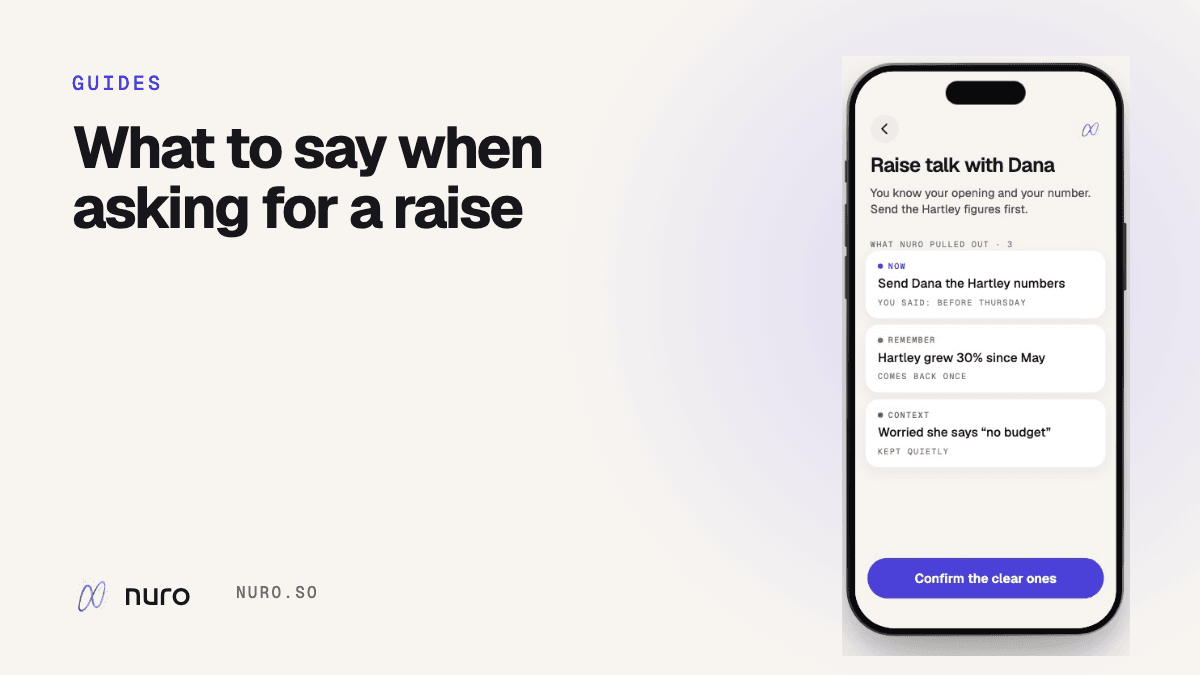
What Nuro does is the step after. You talk through your raise prep, and it transcribes it and keeps the audio, so you can replay exactly how your ask sounded. The entry opens with a one-line summary, and then Nuro suggests what it found: to-dos, things to remember, and context it keeps without turning into tasks. You confirm each one before anything goes on your list.
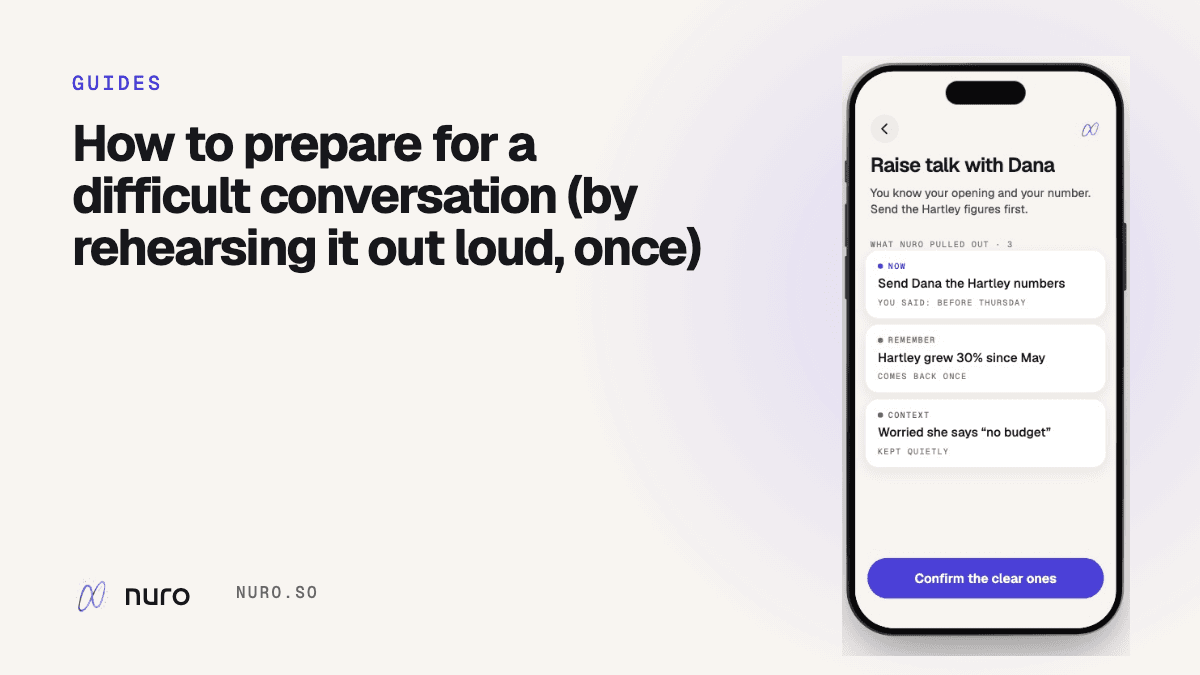
In the rehearsal above, the to-do is sending Dana the Hartley numbers before Thursday. The figure to remember is the 30% growth since May. And "worried she says no budget" stays as context. It's not a task, but it's the reply you know you need to rehearse.
A last word
Asking for a raise is not rude, and it's not a test of whether you deserve to work there. It's a normal conversation that most managers have several times a year. You're allowed to be nervous, and you're allowed to ask for a specific number.
Related reading: How to prepare for a difficult conversation · Should I quit my job? · The science of thinking out loud · Nuro vs ChatGPT voice mode