
Most of what Nuro pulls out of an entry is unambiguous enough to just file: you said "call the dentist," so there's a task called call the dentist. No review needed.
But not everything is that clean. Say you record: "I should probably follow up with Sarah about the proposal sometime before the offsite — not totally sure when that is yet." There's a real task in there, but the due date is a guess at best, and maybe not even that. Filing it as a confirmed to-do with a made-up deadline would be worse than not filing it at all.
That's what Needs You is for.
What actually happens
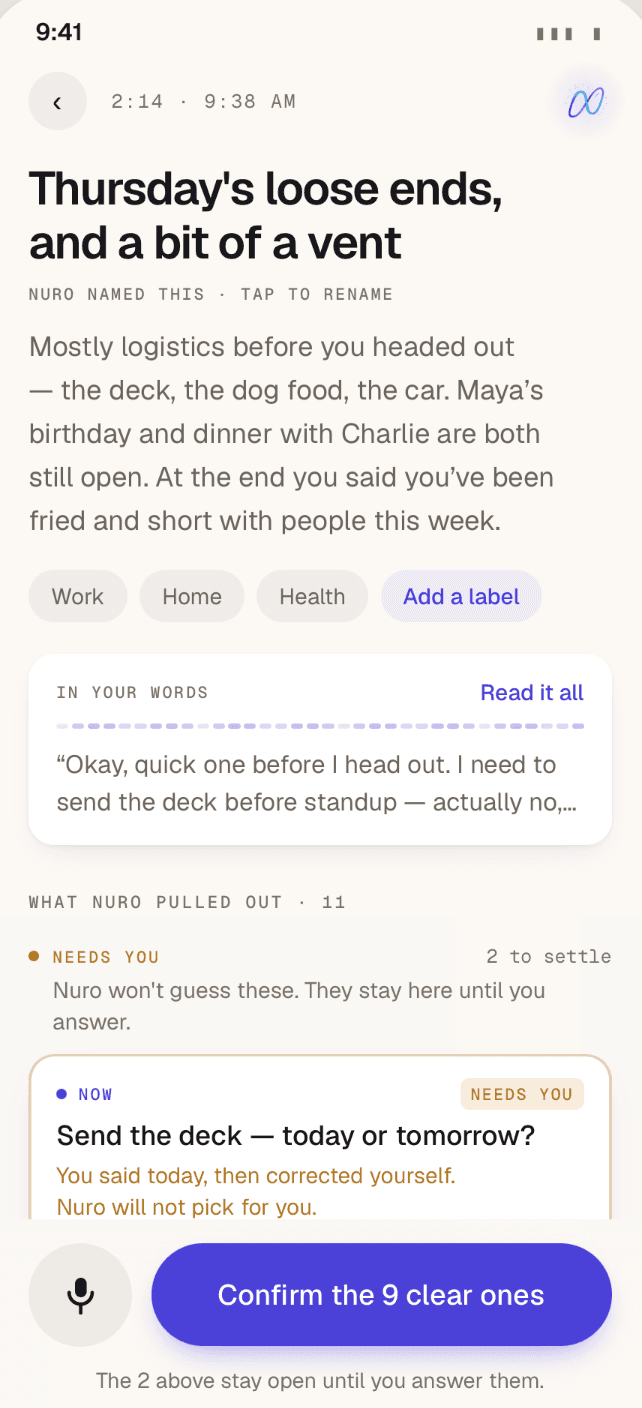
After an entry is analyzed, most of what Nuro found lands directly on your list — actions, themes, categories, all set without asking. The handful of items where Nuro genuinely isn't confident get held back and marked with an amber NEEDS YOU chip instead.
Held items are the ones that won't resolve themselves:
- A task with a due date that's a guess, not a fact from the transcript
- Two things in the same entry that might be the same task, or might not
- A name or detail Nuro can't confidently match to something you've mentioned before
Everything else gets a single footer button — one press, done. The needs-you items don't, on purpose. They're the two or three things in the entry that actually need your judgment, surfaced instead of buried in a list of things you'd otherwise skim past.
Why hold anything back at all
The alternative is Nuro quietly picking an interpretation and moving on. That's fine when it's right and bad when it's wrong — and for the genuinely ambiguous cases, "wrong" is more common than anyone would like. What Nuro's AI can and can't reliably know from a transcript is worth being honest about: names, dates, and half-finished thoughts are easy to misread. Needs You is the app declining to paper over that instead of asking you to catch every mistake after the fact.
What I actually do with it
In practice, this takes a few seconds. I open the entry, see the amber chip on the item that needs a real decision, and either confirm what Nuro guessed, correct it, or dismiss it if it's not actually a task at all. The rest of the entry — the parts Nuro was confident about — I don't have to touch.
It's a small design choice, but it's the difference between a tool that quietly builds a slightly-wrong picture of your to-dos over weeks, and one that asks you the two or three times it's actually unsure.
Related reading: How Nuro works end to end · What an AI journaling app should and shouldn't claim to know