
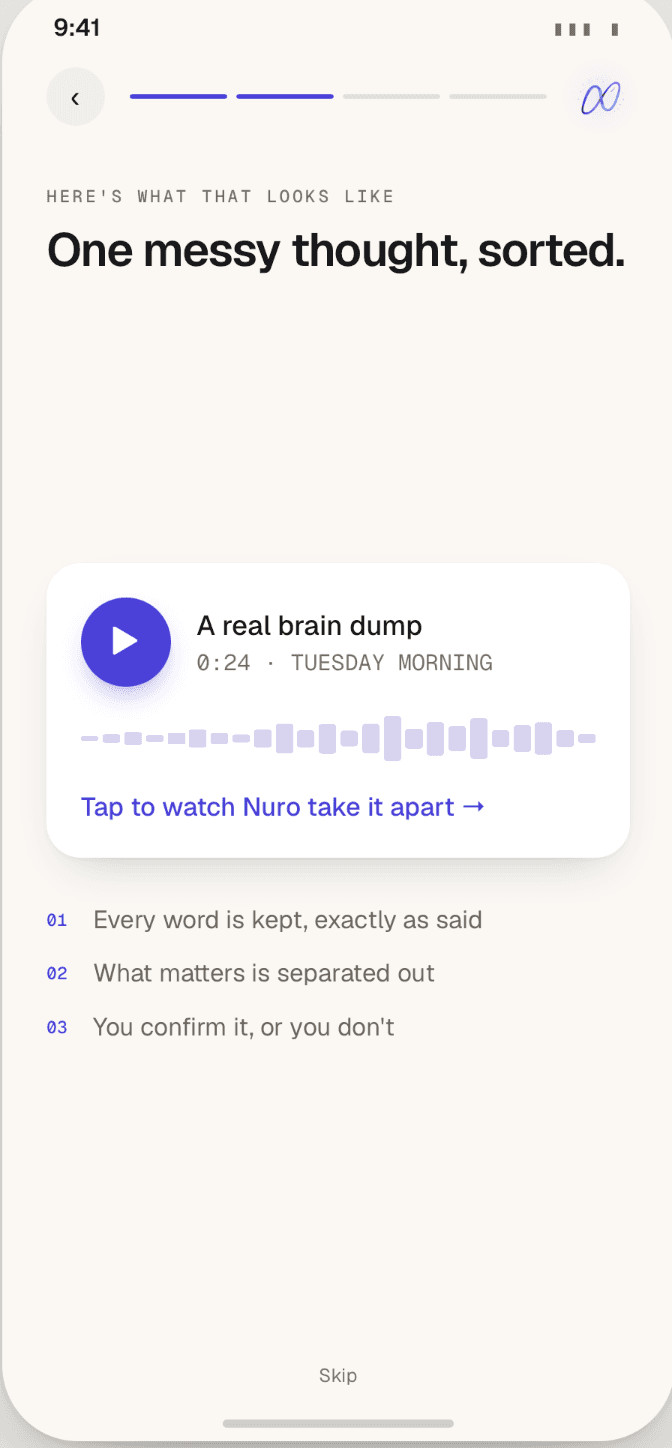
Here's a real shape of entry I record fairly often: "Send the deck to the team before Thursday. Also I keep putting off calling my dentist. And — separate thought — I think the onboarding flow should ask for the goal before the name, not after."
One breath. Three unrelated things: a task with a deadline, a task I'm avoiding, and a product idea that has nothing to do with either. The lazy way to handle that entry is to summarize it as one paragraph and call it done. The useful way is to recognize it's actually three separate things and treat each one as what it is.
What Nuro does with it
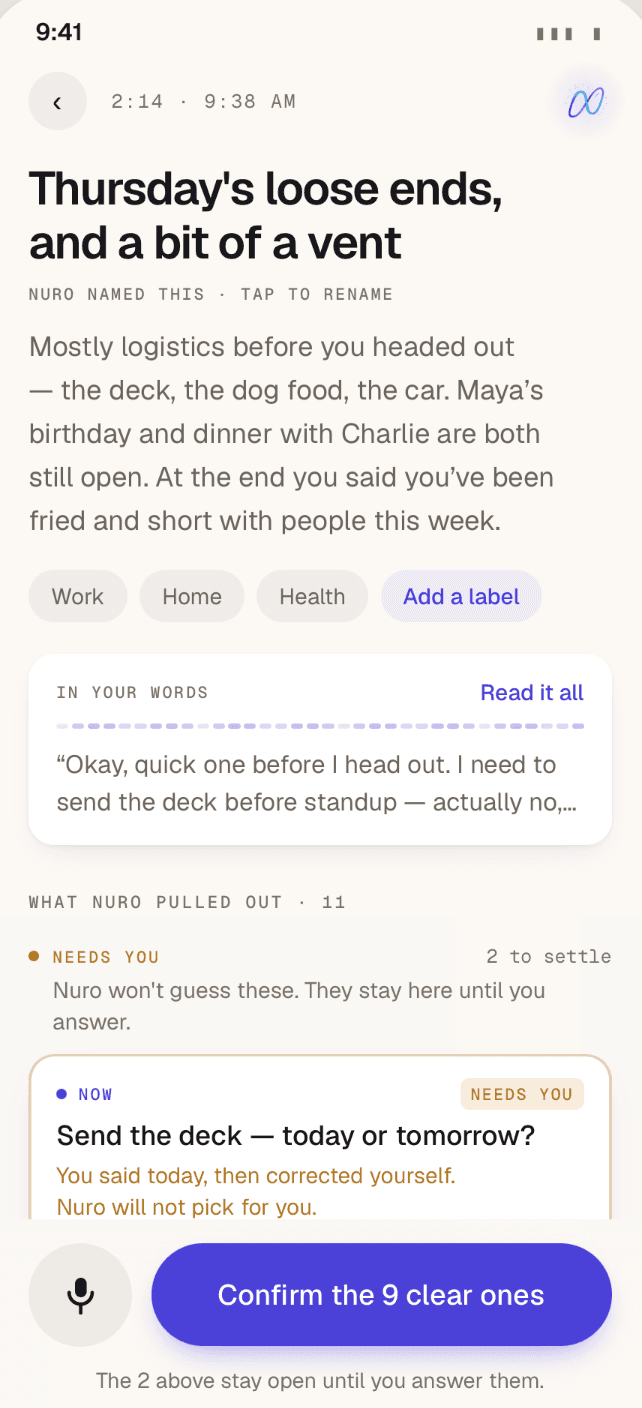
Nuro connects each part of what you said back to the exact stretch of transcript it came from, then proposes it as its own object — its own task, its own idea — rather than folding everything into a single blended note.
- "Send the deck" and "call the dentist" become two separate action items, each with its own transcript span so you can see exactly what you said
- The onboarding-flow thought becomes a separate idea, not a bullet buried inside a to-do
- If something's genuinely uncertain — a date that's a guess, an item that might be a duplicate — it gets held for you to confirm instead of being filed automatically (more on that here)
The point isn't a longer summary. It's not flattening three different kinds of thought into one.
Why this used to be harder to get right
Splitting a mixed entry correctly means telling the difference between "two sentences about the same task" and "two sentences about two different things" — and doing it without losing the parts of the entry that don't cleanly become a task at all, like the dentist-avoidance thought, which is context worth keeping even though it's not an action with a deadline.
This is a case where honesty about limitations matters: Nuro's AI analysis can still be wrong, especially on entries that jump between subjects fast. When it misreads something, the fix isn't to trust the summary less — it's to check the transcript span, which is always kept next to whatever Nuro proposed.
The other half: connecting it to what you've said before
Splitting one entry into its parts is the first step. The second is noticing when something you just said connects to something you said last week — the same project, the same person, the same open question — without Nuro editorializing about it. That's context, surfaced next to the entry, not a conclusion about you.
Related reading: What a brain dump app is actually for · How Nuro works end to end